TL;DR
What Is Customer Perception?
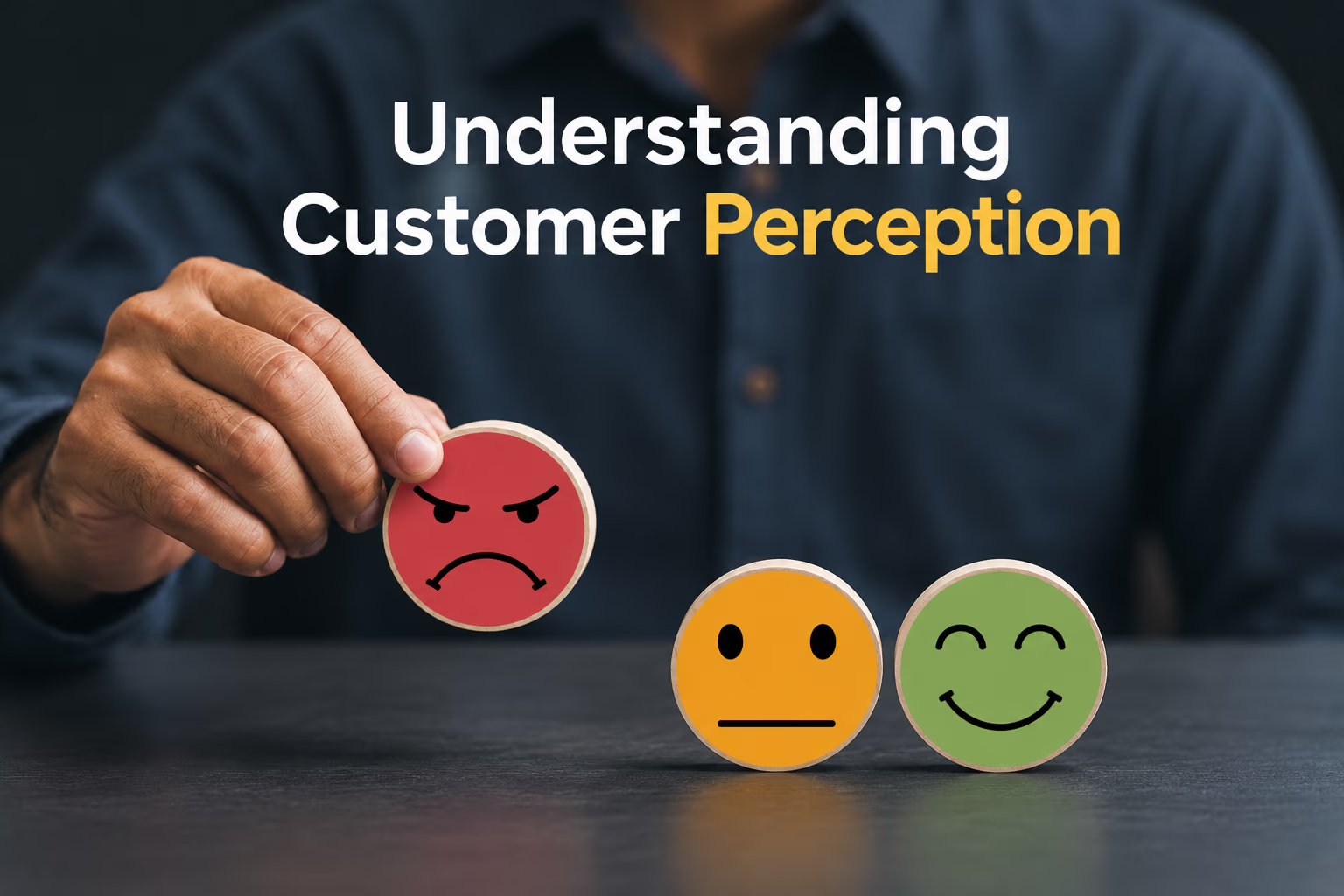
Customer perception is the overall impression customers form about a brand, product, service, or experience based on what they see, hear, experience, and believe.
The simplest customer perception definition is the way customers interpret a business and the value it offers.
That interpretation can be influenced by product quality, pricing, advertising, reviews, customer service, recommendations, previous experiences & comparisons with competitors.
A company may position a product as premium, but customers may perceive it as overpriced. Another brand may describe itself as convenient, while customers experience a complicated purchase process.
This is why the definition of customer perception is broader than whether someone simply likes or dislikes a brand. It includes beliefs about:
- quality;
- value for money;
- reliability;
- trust;
- relevance;
- service;
- reputation;
- overall experience.
When researchers ask what is consumer perception, they are essentially trying to understand how people interpret these signals and how those interpretations influence subsequent decisions.
A useful way to think about the process is:
Brand signal → Customer interpretation → Perception → Decision
Customer perception therefore sits between what a business does and how customers respond to it.
How Customer Perception Is Formed
Customer perception develops through repeated interactions rather than one isolated event.
Before purchase, people may encounter advertising, search results, reviews, recommendations, social conversations, or competitor messaging. These signals help create an initial expectation.
During consideration and purchase, pricing, product information, website usability, availability, packaging, and service can reinforce or challenge that expectation.
After purchase, actual product performance, delivery, support, returns, and communication become more important.
The perception of consumers can also change over time.
A customer who initially sees a product as expensive may later view it as good value after experiencing its quality. A highly trusted brand can lose that perception if service quality falls or expectations repeatedly go unmet.
This is where consumer behaviour and perception connect.
Perception influences how people interpret available choices, while behavior shows what they eventually do.
A customer may perceive one brand as more reliable and choose it over another. Someone who believes a service offers poor value may delay purchase, switch providers, or reduce usage.
However, perception should not automatically be treated as a direct explanation for every action. Price, availability, habit, convenience, need, and competing alternatives can also influence behavior.
That is why good research connects what customers think with what they actually do.
Types of Customer Perception
Customer perception is not one single measure.
People can hold different opinions about different parts of the same brand experience. A customer may trust a company but consider it expensive. Another may like the product but dislike the service.
For business research, six types are particularly useful.
These dimensions often interact.
Consider two consumers looking at the same $100 product.
One compares it with a $60 alternative and sees the product as expensive.
Another values its durability, service, and performance and sees the same price as reasonable.
The price has not changed.
The perceived value has.
This illustrates why businesses need more than objective product information to understand decisions. What matters is the meaning customers attach to that information.
Why Perception in Consumer Behaviour Matters
Perception in consumer behaviour matters because customers make decisions based partly on how they interpret products, brands, prices, and experiences.
The same feature can communicate different things to different audiences. A higher price may signal premium quality to one customer and poor value to another. Limited availability may create exclusivity for one group but inconvenience for another.
These interpretations can influence important commercial outcomes:
- Purchase consideration can increase when a brand is perceived as relevant, credible, and suitable for the customer's needs.
- Conversion can depend on whether perceived value is strong enough to overcome uncertainty, price, or competitive alternatives.
- Price tolerance may be higher when customers associate a product with superior quality, reliability, convenience, or status.
- Retention can strengthen when repeated experiences confirm positive expectations.
- Advocacy becomes more likely when customers believe their experience is worth recommending.
- Switching may increase when negative perceptions around service, value, quality, or trust outweigh the reasons to stay.
This relationship between perception and consumer behavior makes perception useful across more than marketing.
Product teams can understand whether customers interpret features as intended. Pricing teams can test whether customers recognise the value behind a price point. Customer experience teams can find where service interactions are weakening broader brand impressions.
The important point is that perception can sometimes shift before behavior becomes visible in sales or retention data:
- A brand may begin to feel less relevant before customers leave.
- Value may weaken before purchase frequency falls.
- Trust may deteriorate before churn rises.
Tracking these signals gives businesses an opportunity to investigate changes earlier.
How to Measure Customer Perception
Customer perception should not be measured through a single metric.
Customer satisfaction, for example, can indicate whether a particular experience met expectations, but it does not fully explain what customers believe about the brand.
A customer can be satisfied with one transaction while still perceiving the company as expensive, outdated, difficult to trust, or less innovative than competitors.
A stronger approach combines several research methods.
The right method depends on the research question.
If a company wants to understand whether its positioning is working, a brand tracker may be useful.
If it needs to understand why customers perceive pricing negatively, surveys and qualitative research may provide better context.
If teams want to detect emerging shifts that may not yet appear in structured questionnaires, review analysis, open-ended feedback, and Web Intelligence can add another layer.
This is also where AI-native research approaches can help bring fragmented signals together.
Consumer perception increasingly appears across surveys, reviews, digital conversations, behavioral data, and unstructured feedback. Connecting these sources makes it easier to see which perceptions are recurring, which audiences hold them, and where they are changing.
Customer Perception Analysis: From Signals to Decisions
A strong customer perception analysis does more than report whether sentiment is positive or negative.
It identifies what customers believe, why they believe it, how perceptions differ across audiences, and whether those beliefs influence behavior.
Start by collecting relevant signals from surveys, feedback, reviews, behavioral data, and market conversations.
Then group those signals into meaningful dimensions such as trust, quality, price, service, relevance, or innovation.
Compare results across relevant audiences. Perception may differ significantly between loyal customers and new buyers, heavy and light users, different generations, markets, or customer segments.
The analysis should then connect perception with behavioral outcomes where possible.
For example:
- Do customers who perceive higher value purchase more frequently?
- Are people with weaker trust more likely to consider competitors?
- Does a negative service perception appear alongside lower renewal intent?
These questions make consumer behavior perception research more useful because they move beyond description and toward decision-making.
Researchers should also look for gaps between stated perception and actual behavior.
A customer may say price is extremely important but repeatedly buy premium products. Another may report high satisfaction but reduce usage over time.
Those inconsistencies are not necessarily problems in the data.
They may reveal that customer decisions are influenced by factors the original research did not fully capture.
The strongest analysis therefore treats perception as one layer of evidence rather than the complete explanation of behavior.
How Businesses Can Improve Customer Perception
Improving customer perception starts by identifying what is actually creating the unwanted impression.
A negative perception does not automatically mean the brand needs new advertising.
If customers believe a product is expensive, the underlying problem could be price. But it could also be weak value communication, poor differentiation, competitive pressure, or an experience that does not justify the cost.
If customers perceive a business as difficult to work with, the issue may come from onboarding, purchasing, service, communication, or support rather than brand positioning.
The research process should therefore be:
Measure → Identify the gap → Find the cause → Act → Re-measure
This prevents businesses from treating perception problems as communication problems by default.
It also highlights an important principle: there may be no single customers perception that represents the entire market.
Final Thoughts
Customer perception is ultimately about interpretation.
Businesses create products, experiences, prices, communication, and brand promises. Customers decide what those signals mean.
Understanding that difference helps organizations identify whether their intended positioning matches market reality, where perceptions vary across audiences, and which beliefs may be influencing customer decisions.
The strongest approach combines structured research with real customer language, behavioral evidence, competitive context, and signals from the wider market.
BioBrain Insights helps research teams connect surveys, consumer language, behavioral signals, and Web Intelligence to understand how perceptions form, how they change, and where they begin to influence real-world decisions.
Because measuring what customers think is useful.
Understanding why they think it and what they do next is where the real insight begins.
.avif)