TL;DR
What Are Consumer Insights?
Consumer insights are evidence-based interpretations of how people think, feel, choose, behave, and respond within a market. They are created by connecting data with context to explain not only what consumers are doing, but why it is happening and what it could mean for a business.
If the question is what is a consumer insight, the simplest answer is: a consumer insight is a meaningful explanation of a consumer need, motivation, barrier, expectation, or behavior that can support a decision.
That distinction matters because an insight is not the same as a data point.
“Customers abandoned their carts” is an observation.
“Customers are abandoning carts because unexpected delivery costs weaken the value they believed they were getting” is closer to an insight because it explains the behavior and points toward action.
The consumer insights meaning therefore goes beyond collecting information. It involves interpreting evidence well enough to uncover the reason, tension, or opportunity behind what consumers do.
A useful framework is:
Signal → Pattern → Explanation → Insight → Decision
Raw information becomes valuable only when researchers can explain what the pattern means in a real consumer context.
Why Consumer Insights Matter for Business Decisions
Businesses rarely suffer from a lack of data.
They struggle with knowing which signals matter.
Consumer insights help reduce that gap by connecting customer evidence with strategic questions. They can explain why consideration is falling, why one segment responds differently, what makes people switch brands, which barriers prevent adoption, or why an apparently attractive proposition fails to convert.
For teams working across consumer insights, this creates a stronger foundation for positioning, messaging, product development, pricing, customer experience, and growth strategy.
High-quality insights can help organizations:
- identify needs that consumers do not express directly;
- understand the motivations behind purchase and non-purchase;
- detect changing expectations before they become obvious in sales data;
- uncover friction across the customer journey;
- distinguish meaningful segment differences from surface-level variation;
- improve product and communication decisions with evidence;
- challenge internal assumptions about the market.
The value is particularly clear when business data shows what happened but cannot explain why.
Sales may decline.
Usage may fall.
A campaign may underperform.
A product may receive strong awareness but weak conversion.
Those outcomes are signals. Consumer insight helps explain the mechanism behind them.
This is why strong consumer insight market research is not simply about reporting percentages. It is about transforming observed patterns into a clearer understanding of consumer decisions.
From Consumer Data to Real Insight
The biggest mistake in insight work is treating every interesting finding as an insight.
- Statistic can be important without being insightful.
- Theme can be common without being strategically useful.
- Correlation can exist without explaining the behavior behind it.
High-quality insight requires several layers of evidence.
This difference between information and interpretation is central to consumer insight analytics.
The purpose of analytics is not simply to create more charts. It is to establish relationships between signals, compare audiences, identify meaningful deviations, and determine which findings deserve deeper investigation.
The same principle applies to consumer insight data. The quality of an insight depends on whether the underlying evidence is relevant, reliable, sufficiently detailed, and appropriate for the question being asked.
More data does not automatically produce better understanding.
Better evidence does.
Where Consumer Insights Data Comes From
There is no single source of consumer insight.
The strongest work often combines multiple forms of evidence because different sources answer different questions.
Strong consumer insights data usually comes from connecting these sources instead of relying on one in isolation.
For example, transaction data may show that a segment buys less frequently, while interviews reveal that the product is now perceived as less relevant. Open-ended survey responses may identify a recurring frustration, and broader web conversations may show the same theme gaining momentum across the category.
Together, these signals create a richer explanation than any one dataset could provide.
A consumer behavior survey can be particularly useful when the research needs to connect actions with motivations, barriers, intentions, and attitudes. But survey findings become stronger when compared with observed behavior rather than treated as complete proof on their own.
How to Generate Consumer Insights
Generating meaningful insight requires a disciplined process. The goal is not to search for interesting numbers after fieldwork. It is to start with a decision problem and build the research around it.
1. Define the decision
Begin with the business question.
Instead of asking, “What do consumers think about our brand?”, define a sharper question such as:
- Why are first-time buyers not returning?
- What prevents consideration among younger consumers?
- Which value signals influence premium purchase?
- What is driving switching within a key segment?
A clear decision question prevents research from becoming a collection of disconnected findings.
2. Collect the right evidence
Choose data sources based on the problem.
Attitudinal questions may require surveys. Complex motivations may require qualitative interviews. Actual purchase behavior may require transaction data. Emerging conversations may require Web Intelligence.
Strong consumer insight research uses the method that fits the question rather than forcing every problem into the same research design.
3. Look for patterns and differences
The next step is to identify where behavior, attitudes, or perceptions differ.
Compare groups.
Track changes over time.
Examine high and low performing segments.
Look for contradictions between stated attitudes and actual behavior.
An analysis of consumer decisions becomes more valuable when it explains why one audience behaves differently from another rather than reporting an average that hides variation.
4. Add context
Patterns need interpretation.
A drop in purchase frequency can have many explanations: higher prices, weaker relevance, competitor activity, changing needs, availability, poor experience, or a different customer mix.
Context helps researchers avoid turning correlation into an unsupported conclusion.
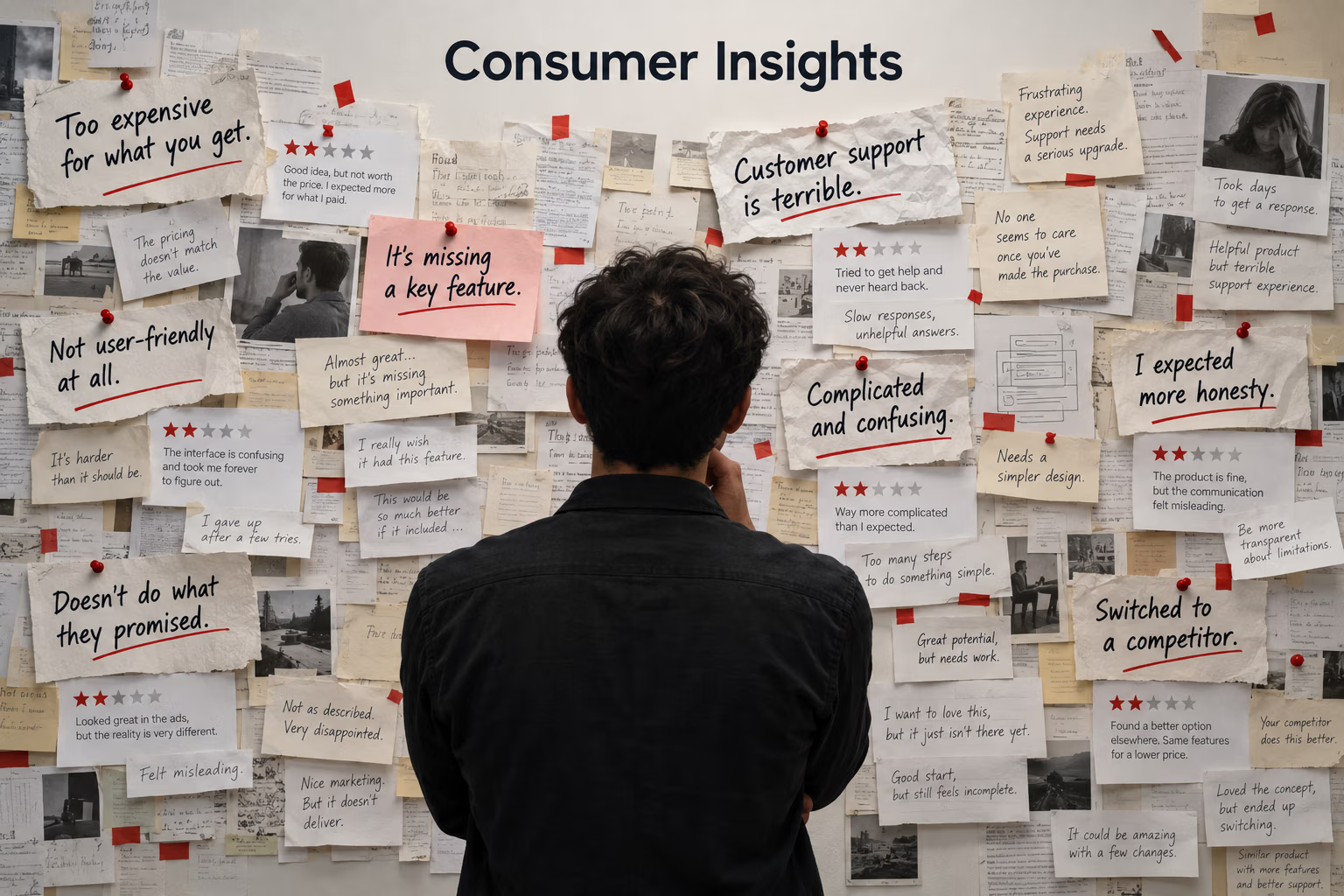
This is where qualitative evidence and consumer perspectives become especially important. The language people use can reveal motivations, frustrations, expectations, and trade-offs that structured metrics alone may miss.
5. Validate the explanation
A strong insight should survive challenge.
Researchers should ask:
- Does the explanation appear across multiple data sources?
- Is the pattern consistent across relevant groups?
- Are there alternative explanations?
- Does observed behavior support what consumers say?
- Could sampling, survey design, or data quality be influencing the result?
Validation prevents an appealing story from being mistaken for a reliable insight.
6. Connect the insight to action
An insight should change how the business understands a problem or opportunity.
If it does not influence a decision, test, priority, or hypothesis, it may still be an interesting finding but it is not yet strategically useful.
The best insight often creates a clear next question:
If this is true, what should we do differently?
Consumer Insights Analytics: Turning Patterns Into Explanation
Modern research increasingly requires teams to connect structured and unstructured evidence.
Structured data can measure frequency, magnitude, relationships, and differences. Unstructured evidence can explain language, emotion, experience, and emerging themes.
Effective consumer insights analytics brings these together.
For example, a brand may see that consideration has declined among a particular audience. Quantitative research can establish the size of the decline. Open-ended feedback can reveal recurring value concerns. Competitive research may show stronger alternatives entering the consideration set. Behavioral data can indicate which customers are actually switching.
The insight is not any one of those findings.
The insight emerges from the relationship between them.
This is also where consumer insights market research is changing. Research teams are increasingly expected to move beyond reporting individual metrics and toward connecting survey evidence, behavior, market context, and unstructured consumer language.
That requires both analytical capability and strong research judgment.
It also requires the right consumer skills on the research side: understanding how people compare alternatives, interpret value, respond to information, form habits, and make trade-offs.
Tools can surface patterns.
Researchers still need to determine what those patterns mean.
What Makes a High-Quality Consumer Insight?
Not every finding should be elevated to insight status.
Strong insights tend to have five characteristics.
- Relevant: The finding connects directly with a meaningful business or consumer problem.
- Evidence-based: It is supported by reliable information rather than assumption or anecdote.
- Explanatory: It helps clarify why a behavior, perception, or outcome exists.
- Specific: It identifies the audience, context, or condition under which the insight applies.
- Actionable: It gives teams a clearer direction for research, strategy, product, experience, or communication.
This standard is especially important when using consumer insights and research to support high-stakes decisions.
Consider the difference:
“Consumers care about convenience.”
That is broad and difficult to act on.
“First-time buyers value convenience most during setup, where added complexity reduces confidence before product benefits are experienced.”
That is more specific. It identifies an audience, a moment, a tension, and a potential intervention.
The second statement gives the business something it can investigate or change.
That is the difference between describing consumers and understanding them.
Final Thoughts
Consumer insights are most powerful when they turn scattered signals into a clearer understanding of what consumers need, why they behave the way they do, and what the business should do next.
The goal is not more data. It is better interpretation connecting quantitative evidence, qualitative context, behavioral signals, and real consumer language into insight that can actually guide decisions.
BioBrain Insights helps research teams bring these signals together, identify the patterns that matter, and turn complex consumer evidence into faster, clearer, decision-ready intelligence.
Because the best insight does more than explain the past it reveals what deserves attention next.
.avif)