Halloween is fun. The experience around it is more complicated.
Costumes, candy, parties, and seasonal displays make Halloween look like one night of uncomplicated fun. But when the celebration moves into streets, workplaces, household budgets, and next-day schedules, a different story begins to emerge.
A BioBrain study explored the responses of 1K+ modeled U.S. consumers aged 18 and older. The findings reveal five points of friction that sit behind the celebration from the concern people carry into Halloween night to the fatigue that follows them into the next morning.
Here are five Halloween consumer findings that brands, employers, and decision-makers should keep in view.
1. For 47%, Halloween’s biggest community concern is on the road
Nearly half of modeled U.S. consumers selected reckless driving and pedestrian safety as their biggest concern on Halloween night. That is more than twice the share who chose excessive drinking and disruptive behavior at 21%.
Vandalism and property damage followed at 18%, while crowds, noise, and neighborhood disruption ranked last at 14%.
The leading concern is not the costume, the crowd, or the prank. It is the journey through the neighborhood. For organizations communicating around Halloween, practical safety, visibility, and mobility may feel more relevant than another generic seasonal message.
2. Workplace Halloween creates more resistance than enthusiasm
Among employed adults, 41% said dressing up for Halloween makes work more fun. That is a meaningful group but it is not the majority.
Taken together, 59% selected a point of resistance instead: 21% described workplace costumes as awkward in a professional setting, 19% disliked the additional cost or effort, and another 19% preferred not to participate.
The finding is not a case against workplace celebration. It is a reminder that optional needs to feel genuinely optional. The most inclusive Halloween activity may be one that creates room for enthusiasm without making participation another workplace obligation.
3. Halloween leaves 69% with something to regret
For most adults who had celebrated Halloween previously, the morning after came with at least one regret.
Staying up late or overindulging ranked first at 27%, closely followed by spending too much at 26%. Another 16% pointed to the cleanup and waste left behind. Only 31% selected no regrets.
What stands out is that regret does not come from one dominant behavior. It is distributed across time, money, and effort. Halloween’s hidden cost is not only what people buy; it is also what the celebration asks from them before, during, and after the night itself.
4. The celebration follows one in three people into the next day
Halloween may end at midnight, but its effects do not always stop there.
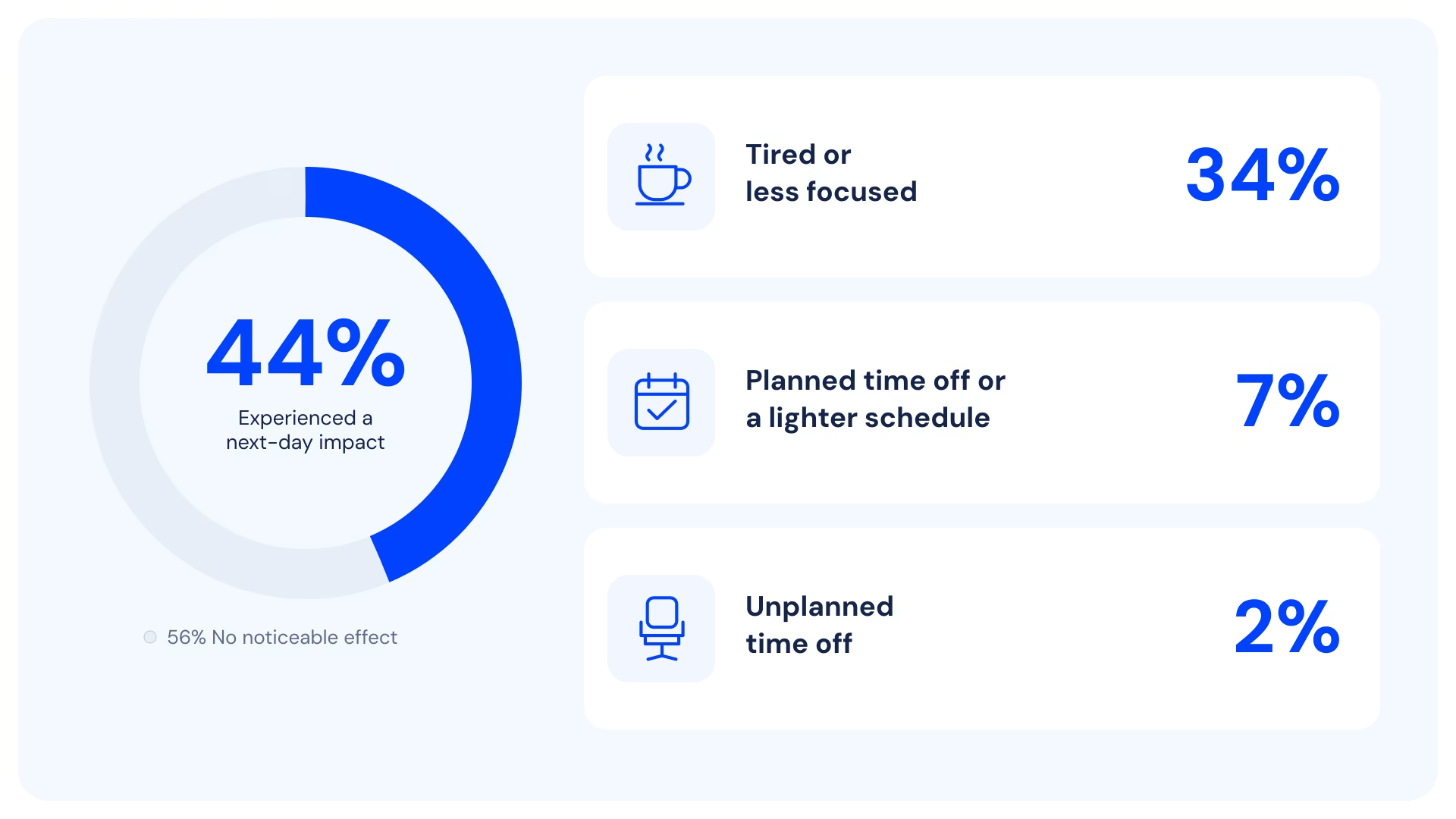
Among consumers, 34% said they typically feel tired or less focused. A further 7% arrange time off or a lighter schedule, while 2% take unplanned time off. Combined, 44% report some effect on their next-day routine.
This makes the morning after part of the Halloween experience. For employers, educators, and brands, November 1 can be as behaviorally relevant as October 31 especially when Halloween falls before a work day.
5. Early Halloween shelves attract attention not necessarily more spending
Halloween now appears in stores long before October, but earlier visibility does not automatically create a larger basket.
The leading response, selected by 31%, was enjoying the early product selection without changing spending habits. At the same time, 29% said early displays make Halloween feel over-commercialized. Another 27% said they build excitement, while 13% felt pressured to plan or buy sooner.
The signal for retailers is more nuanced than “earlier is better.” Early merchandise can support discovery and planning, but attention should not be mistaken for incremental demand. Halloween may arrive early in stores, while the extra spending never arrives with it.
Halloween planning should not end on October 31
These findings tell a broader story than a single night of costumes and candy. Halloween begins months earlier in retail, enters neighborhoods and workplaces, influences household spending, and continues into the next morning.
For brands and decision-makers, the opportunity is to understand the entire experience not only the moment of celebration. The strongest strategies will recognize the trade-offs consumers are already making across safety, participation, time, money, and convenience.
If you need deeper audience cuts, custom studies, or category-specific intelligence, BioBrain Insights can take your research beyond the surface.
Ready to go deeper? Let’s collaborate.