AI is no longer a future-facing concept in the GCC. It is becoming part of how governments, businesses, platforms, and consumers interact with information, services, brands, and decisions.
Across the Middle East, the economic impact is expected to be significant. PwC estimates that AI could contribute $320 billion to the Middle East economy by 2030, with Saudi Arabia expected to capture around $135.2 billion and the UAE seeing AI contribute close to 14% of GDP by 2030.
The infrastructure push is equally visible. Reuters reported that the Gulf is expected to invest around $800 billion in AI infrastructure over two years, while the UAE and Saudi Arabia continue expanding data centers, cloud capacity, and AI partnerships. Microsoft and G42 also announced a 200 MW data center capacity expansion in the UAE, part of Microsoft’s wider Gulf investment plan.
Consumer perception is evolving too. Globally, KPMG’s AI trust study found that 66% of people use AI regularly, but only 46% are willing to trust AI systems, showing a clear gap between usage and confidence. In Saudi Arabia, one 2026 national survey found that 93% of respondents actively use generative AI, mainly for text-based tasks, while still raising concerns around privacy, misinformation, ethics, and overreliance.
That tension matters.
People are using AI, but they do not automatically trust it. Businesses are adopting AI, but they still need accuracy, transparency, and expert validation. Governments are investing in AI, but responsible use, cultural context, and data quality remain central concerns.
For research teams, this is where AI market research GCC becomes highly relevant. It is not just about automating reports. It is about moving from slow, fragmented research workflows to sharper consumer intelligence systems that combine technology, human expertise, and local market understanding.
What Is AI Market Research?
AI market research is the use of artificial intelligence to support or enhance research activities such as data collection, text analysis, survey automation, respondent validation, sentiment classification, theme detection, reporting, and insight synthesis.
In simple terms, AI helps research teams process more information faster.
It can work across:
- Surveys
- Open-ended responses
- Interview transcripts
- Focus group discussions
- Reviews and ratings
- Social conversations
- Search behavior
- Web and forum discussions
The goal is not speed alone. Speed without accuracy creates risk.
The real value lies in helping researchers convert high-volume, messy, multilingual, and unstructured information into usable intelligence. This is especially important for market research UAE, market research saudi arabia, and wider Gulf studies because consumer conversations often happen across Arabic, English, Arabizi, Hindi, Urdu, Malayalam, Tagalog, and mixed-language digital spaces.
A researcher may carefully read 100 open-ended responses. AI can help organize 10,000. But the interpretation still needs human review, category knowledge, and cultural context.
From Automation to Consumer Intelligence
The first wave of research automation GCC focused on efficiency.
It helped research teams automate repetitive steps such as:
- Survey scripting
- Questionnaire checks
- Quota monitoring
- Data cleaning
- Chart creation
- Basic reporting
That was useful, but limited.
The newer wave is about intelligence. Instead of asking only, “How do we finish this project faster?” brands are asking, “How do we understand more consumer signals, more often, with better context?”
This is the real shift.
Traditional research usually moves from brief to fieldwork to analysis to report. AI-supported intelligence can connect surveys with reviews, social sentiment, search behavior, customer feedback, and competitor signals.
That matters because today’s consumers rarely express themselves in one place.
A product may perform well in a survey but receive negative reviews for delivery. A campaign may get high engagement but weak trust in comments. A service may show decent satisfaction scores but reveal deep frustration in complaint logs.
AI helps bring those signals together.
Where AI Helps Most
AI is most useful where research teams face volume, complexity, speed pressure, or unstructured data.
1. Open-Ended Response Analysis
Open-ended survey responses often contain the richest insight. They show how consumers explain decisions in their own words.
But they are difficult to analyze manually at scale.
AI can help group responses into themes such as:
- Price concerns
- Trust barriers
- Delivery issues
- Product quality
- Feature requests
- Service frustration
- Purchase hesitation
- Brand preference
This is useful when thousands of respondents explain why they bought, rejected, switched, complained, or recommended a brand.
However, AI should not be treated as final judgment. Researchers still need to check whether the themes are accurate, commercially meaningful, and culturally appropriate.
2. Qualitative Research at Scale
Qualitative research GCC is changing because interviews, focus groups, and diaries can now be analyzed faster.
AI can support:
- Transcript summarization
- Theme extraction
- Quote clustering
- Emotion mapping
- Contradiction detection
- Segment comparison
- Research note synthesis
This does not remove the role of a researcher. It makes the researcher’s role more important.
AI may detect repeated themes, but it may not understand why someone hesitates, laughs, avoids direct criticism, softens disagreement, or uses culturally specific phrasing. In Gulf markets, communication style, family context, privacy, trust, and status can shape how people speak.
The best workflow is simple:
AI organizes. Researchers interpret. Businesses decide.
3. Sentiment Intelligence
Sentiment analysis is one of the most visible AI use cases in research. It helps brands understand whether consumer conversations are positive, negative, neutral, mixed, frustrated, excited, skeptical, or urgent.
It can be applied to:
- Social posts
- App reviews
- Marketplace ratings
- Survey open-ends
- Complaint forms
- Chat transcripts
- Forum discussions
But sentiment in the GCC is not always straightforward.
Arabic dialects, English-Arabic mixing, sarcasm, emojis, religious expressions, brand slang, and platform-specific language can confuse automated systems. A short comment may look neutral but carry strong disappointment. A sarcastic phrase may be classified as praise. A delivery complaint may be wrongly treated as a product issue.
The goal is not to count positive and negative comments. The goal is to understand which emotions are connected to which business problems.
4. Real-Time Consumer Intelligence
Traditional research can take weeks. AI-assisted monitoring can help brands detect signals much faster.
This is useful for tracking:
- Campaign reactions
- Product launch feedback
- Service failures
- Competitor movement
- Review spikes
- Pricing backlash
- Reputation risks
- Category trends
- Emerging needs
In the GCC, real-time intelligence is especially useful around Ramadan, tourism seasons, shopping festivals, public events, entertainment launches, and viral social conversations.
But real-time does not mean reacting to everything.
It means identifying which signals deserve deeper investigation before they become bigger problems.
GCC Adoption: Why the Region Is Moving Fast
The GCC is not approaching AI passively. National strategies, public-sector initiatives, enterprise investments, and infrastructure programs are accelerating adoption.
The UAE Strategy for Artificial Intelligence aims to boost government performance, support priority sectors, develop AI talent, strengthen research capability, and provide the data and infrastructure needed to become a test bed for AI. Saudi Arabia’s SDAIA drives the national data and AI agenda and is positioned as a key force behind the Kingdom’s ambition to become a global AI leader.
Private-sector investment is also rising. Salesforce announced plans to invest $500 million in AI-related projects in Saudi Arabia, including Arabic language support for AI products, a regional headquarters in Riyadh, and plans to upskill 30,000 Saudi citizens by 2030. Reuters also reported that LEAP 2025 attracted $14.9 billion in AI investments.
This matters for consumer insights for GCC brands because AI capability depends on more than tools. It depends on infrastructure, local language support, governance, data quality, talent, and responsible use.
The region is building those foundations quickly.
Use Cases for GCC Brands
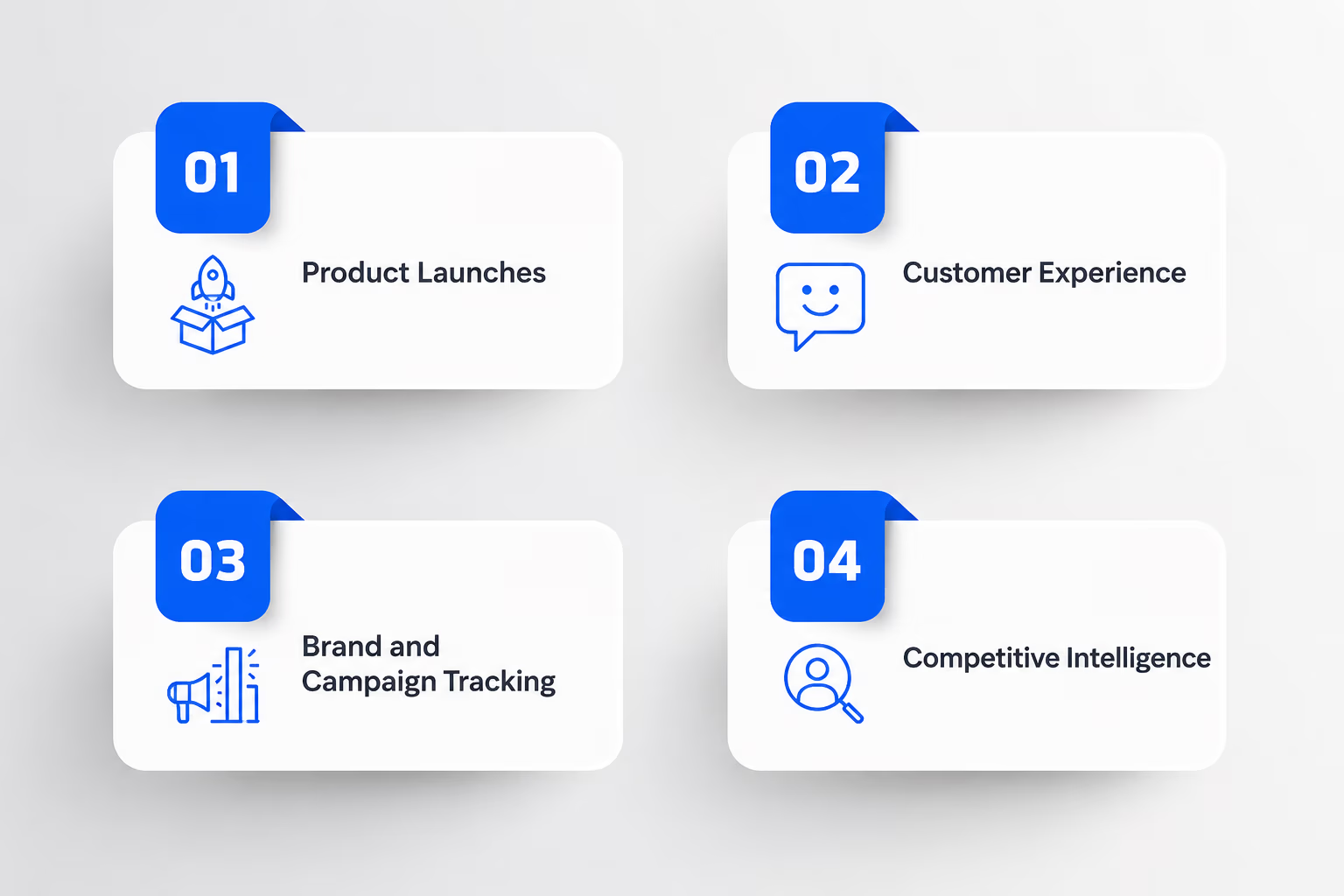
AI market research can support many business decisions, but several use cases are especially relevant.
1. Product Launches
Before launch, AI can help analyze concept feedback, open-ended reactions, competitor conversations, and early objections.
After launch, it can monitor reviews, complaints, social posts, and support tickets.
Brands can answer:
- What are people praising?
- What is confusing them?
- Which objections repeat?
- Are problems product-related, service-related, or communication-related?
2. Customer Experience
Customer experience data is often scattered across surveys, call centers, delivery apps, chat logs, app reviews, and complaint forms.
AI can cluster recurring problems such as:
- Late delivery
- App crashes
- Poor staff response
- Payment failures
- Refund delays
- Unclear pricing
- Weak after-sales support
This helps teams move from anecdotal complaints to structured CX intelligence.
3. Brand and Campaign Tracking
AI can monitor how people respond to campaigns across social platforms, comments, reviews, creator content, and forums.
It helps brands understand:
- Is the campaign understood?
- Which claim creates trust?
- Which message causes confusion?
- Are people praising, questioning, mocking, or ignoring it?
For multilingual campaigns, this is especially useful because interpretation can differ across language groups.
4. Competitive Intelligence
AI can track competitor mentions, review patterns, pricing complaints, feature requests, and category conversations.
The value is not simply knowing that a competitor is being discussed. The value is understanding why they are gaining trust, where they are failing, and which unmet needs remain open.
Risks in AI Market Research
AI brings speed and scale, but it also creates risks.
Important risks include:
- Misclassified sentiment
- Poor handling of mixed-language text
- Biased training data
- Weak respondent validation
- Overreliance on automation
- Confusing online noise with real demand
- Unsupported AI-generated summaries
- Privacy and consent gaps
- Lack of source traceability
These risks matter because research supports decisions. A polished AI summary can be dangerous if it is wrong.
For Gulf markets, language and cultural context are especially important. Arabic dialects, Arabizi, English slang, multilingual respondents, and local expressions require careful validation.
AI should accelerate research discipline, not replace it.
What Good AI Research Looks Like
Strong AI-enabled research should follow a quality framework.
It should include:
- Clean and relevant data inputs: AI outputs are only reliable when the source data is accurate, complete, and aligned with the research objective.
- Transparent methodology and traceability: Teams should know where the data came from, how it was processed, and which sources support each insight.
- Human validation and bias checks: Researchers must review AI outputs to catch misclassification, cultural errors, bias, or unsupported conclusions.
- Actionable and responsible interpretation: Good AI research should protect privacy, state limitations clearly, and translate findings into practical business decisions.
This is where modern research becomes more balanced.
Automation handles repetitive work. AI detects patterns. Researchers validate meaning. Business teams decide what action to take.
The result is not just faster reporting. It is stronger intelligence.
Final Thoughts
The next phase of AI market research GCC is not about replacing surveys, interviews, or researchers. It is about connecting them with faster analysis, wider signal coverage, and stronger interpretation.
For teams working across Gulf markets, the opportunity is clear: AI can help transform research from a slow, project-based function into a continuous consumer intelligence system.
But speed alone is not the win.
The real advantage comes when AI-supported analysis is paired with human expertise, local context, quality controls, and responsible methodology.
In markets where consumers are digital, multilingual, culturally diverse, and fast-changing, the brands that win will not be the ones collecting the most data. They will be the ones that understand the right signals first - and act on them with confidence.


.avif)