The GCC is entering a new research reality: conversations are multiplying faster than teams can manually analyze them. Every interview, focus group, open-ended survey response, review, call transcript, complaint thread, and social post carries a fragment of consumer truth. The challenge is no longer access to feedback. The challenge is turning that feedback into defensible insight without flattening the human context behind it.
That is where AI qualitative research is becoming important.
It helps research teams process rich, unstructured data faster while still preserving the nuance that makes qualitative work valuable in the first place.
The timing makes sense. The GCC artificial intelligence market was valued at $6.22 billion in 2025 and is projected to reach $23.03 billion by 2034, growing at a 14.87% CAGR. AI adoption is also becoming mainstream among consumers and professionals. A KPMG UAE study found that 97% of UAE respondents use AI for work, study, or personal purposes. In Saudi Arabia, a 2026 national survey found that 93% of respondents actively use generative AI, mainly for text-based tasks.
But there is a trust gap, while 66% of people use AI regularly, only 46% are willing to trust AI systems. For qualitative research, that gap matters. AI can accelerate analysis, but the insight must still be traceable, culturally aware, and reviewed by researchers who understand the market.
What AI Qualitative Research Means
AI qualitative research is the use of artificial intelligence to support the analysis of interviews, focus groups, diaries, open-ended responses, reviews, and other text or voice-based consumer inputs.
It can help with:
- Transcript cleaning
- Theme detection
- Quote clustering
- Emotion tagging
- Sentiment classification
- Segment comparison
- Contradiction detection
- Summary generation
But good qualitative research is not just summarization.
A strong analyst does not only ask, “What did people say?” They ask, “What did they mean, what did they avoid saying, what changed in their tone, what language repeated across segments, and what does this reveal about behavior?”
This distinction is especially important in qualitative research UAE and qualitative research Saudi Arabia, where language, nationality, culture, income, family context, privacy, service expectations, and social norms can shape how people express themselves.
AI can organize the material. Human researchers must still interpret it.
Why Qualitative Analysis Is Hard in GCC Markets
Qualitative work in the Gulf is rarely straightforward. Consumers may speak in English, Arabic, Arabizi, Hindi, Urdu, Malayalam, Tagalog, or mixed-language phrases. A single respondent may shift languages depending on emotion, comfort, or topic.
That makes analysis complicated.
A direct complaint in one culture may be softened in another. Sarcasm may look positive in text. A respondent may avoid saying “I don’t trust this brand” and instead say, “I would need to check more.” In a focus group, a participant may agree publicly but express hesitation later in a diary or interview.
These are not minor details. They are often the insight.
For example:
- In luxury research, hesitation may signal price sensitivity, status anxiety, or lack of brand trust.
- In healthcare, a “booking issue” may actually reflect language discomfort or insurance confusion.
- In fintech, low adoption may not mean low interest; it may mean weak confidence in security.
- In retail, a complaint about “service” may refer to delivery, staff behavior, refund delays, or app support.
AI can detect recurring words. The researcher must decode the meaning behind them.
IDI Analysis: From Long Conversations to Decision Signals
In-depth interviews are one of the most valuable qualitative methods because they allow respondents to explain personal motivations, barriers, and decision journeys.
For GCC brands, IDIs are useful in categories such as:
- Healthcare
- Banking
- Insurance
- Real estate
- Luxury
- Education
- Fintech
- Automotive
The challenge is scale. Ten interviews may generate hundreds of pages of transcripts. Twenty interviews can create a large body of unstructured material that takes days to review properly.
AI can help by identifying:
- Repeated motivations
- Trust barriers
- Emotional triggers
- Purchase objections
- Service pain points
- Decision moments
But this is where shallow summaries become risky.
A weak AI summary may say: “Consumers want convenience and trust.” That is not insight. That is a label.
A defensible IDI finding would go deeper: “First-time fintech users are not rejecting digital onboarding because they dislike apps; they hesitate when identity verification feels irreversible, fees are unclear, or support feels inaccessible.”
That kind of insight connects language to behavior. It is specific enough to guide action.
FGD Analysis: Reading Group Dynamics, Not Just Comments
Focus groups are powerful because they show how people react socially. Participants build on each other’s comments, challenge claims, repeat category language, and reveal how ideas gain or lose credibility in a group.
This is especially useful for focus group research Dubai, where brands often test concepts, campaigns, packaging, service propositions, or premium positioning among diverse audiences.
AI can help process FGD transcripts by clustering themes and identifying repeated reactions. But focus groups are not only text. They are dynamics.
A good analyst watches for:
- who speaks first
- who influences the group
- when agreement feels genuine
- when silence signals discomfort
- which claims create debate
- which words participants repeat naturally
AI may detect that “price” was mentioned 42 times. A researcher must understand whether price was a barrier, a quality cue, a negotiation point, or a comparison trigger.
In GCC focus groups, this matters because participants may respond differently depending on gender, age, nationality, language, income, and group comfort. Mixed groups can produce polite answers. Segmented groups can reveal sharper truth.
Voice, Text, and Emotion: The New Qualitative Layer
Qualitative data is no longer only written transcripts. Modern research includes voice recordings, video calls, mobile diaries, chat-based interviews, app feedback, review comments, and open-text survey responses.
AI can help convert voice into text, organize transcripts, detect emotional cues, and compare themes across segments. Market research transcription tools are increasingly positioned around faster, searchable, more accurate documentation of interviews and focus groups.
But emotion is not always obvious.
A respondent may sound calm while describing a serious frustration. Another may use humor to soften criticism. Someone may repeatedly pause before answering a question about trust, privacy, or price. These signals matter.
For consumer interviews UAE, emotion can reveal what fixed survey answers miss:
- fear of being misled,
- frustration with service,
- hesitation around payment,
- pride in local relevance,
- discomfort with unclear claims,
- or anxiety about after-sales support.
AI can help tag emotional language, but human validation is needed to avoid misreading tone, sarcasm, cultural politeness, or mixed-language expressions.
Avoiding Shallow Summaries
The biggest risk in AI-supported qualitative work is not that AI will be too slow. It is that AI will be too neat.
Qualitative research is messy because people are messy. Respondents contradict themselves. They say one thing and do another. They rationalize decisions. They avoid direct criticism. They use cultural shorthand. They express trust through stories rather than scores.
Shallow summaries often produce generic findings like:
- “Consumers want convenience.”
- “Price is important.”
- “Trust matters.”
- “People prefer better service.”
These may be true, but they are not useful.
A stronger AI-assisted qualitative workflow should ask:
- What is the specific trigger behind this theme?
- Which audience segment said it most strongly?
- Is this a stated preference or a behavioral barrier?
- What evidence supports the conclusion?
- Which quotes show the nuance?
- What contradictions appeared?
- What business decision does this change?
This is where frameworks such as Recency, Relevance, and Resonance become useful. A strong RRR-style lens helps teams prioritize recent signals, filter for business relevance, and focus on authentic consumer narratives rather than noisy or generic comments.
Building Defensible Qualitative Insights
Defensible insight means the finding can survive scrutiny. It is not just an interesting quote or a polished AI-generated paragraph. It is supported by evidence, segment context, and clear reasoning.
A defensible qualitative insight should include four things:
- Source clarity: where the finding came from, such as IDIs, FGDs, diaries, reviews, or open-ended survey responses.
- Segment context: who said it, including market, audience type, language, category usage, or customer group.
- Evidence pattern: whether the theme repeated across participants, appeared strongly in one segment, or contradicted other data.
- Business meaning:: what the finding suggests for product, pricing, communication, CX, or market strategy.
This is where AI can strengthen the analyst’s work. It can help retrieve quotes, compare themes, identify outliers, and surface contradictions. But it should not hide the trail of evidence.
Good qualitative intelligence is explainable.
Use Cases in UAE and Saudi Arabia
AI-supported qualitative research can be valuable across many GCC business questions.
In the UAE, it can help brands understand:
- why customers abandon premium services,
- how expat and national audiences describe trust differently,
- what tourists expect from hospitality experiences,
- which retail service gaps reduce repeat visits,
- and how multilingual users interpret campaign claims.
In Saudi Arabia, it can help teams explore:
- how young consumers define authenticity,
- what makes ecommerce experiences feel reliable,
- how family context shapes purchase decisions,
- which entertainment and lifestyle experiences create excitement,
- and where Arabic messaging feels natural versus forced.
The key is not to compare countries as stereotypes. The key is to let consumer language reveal decision logic.
Where InstaQual and Web Intelligence Fit
Modern qualitative analysis is expanding beyond the interview room. Tools and workflows such as InstaQual can help teams accelerate the processing of interviews, focus groups, and open-ended feedback into structured themes and emotional signals.
At the same time, Web Intelligence adds another layer by reading open-web signals such as reviews, forums, search behavior, social conversations, creator content, and complaint threads. This helps researchers compare what consumers say in formal research with what they express naturally online.
That combination is powerful.
If interview respondents say they value “quality,” but reviews repeatedly mention delivery damage, refund delays, or weak support, the real issue may not be product quality alone. It may be confidence in the experience surrounding the product.
AI Guardrails for Qualitative Research
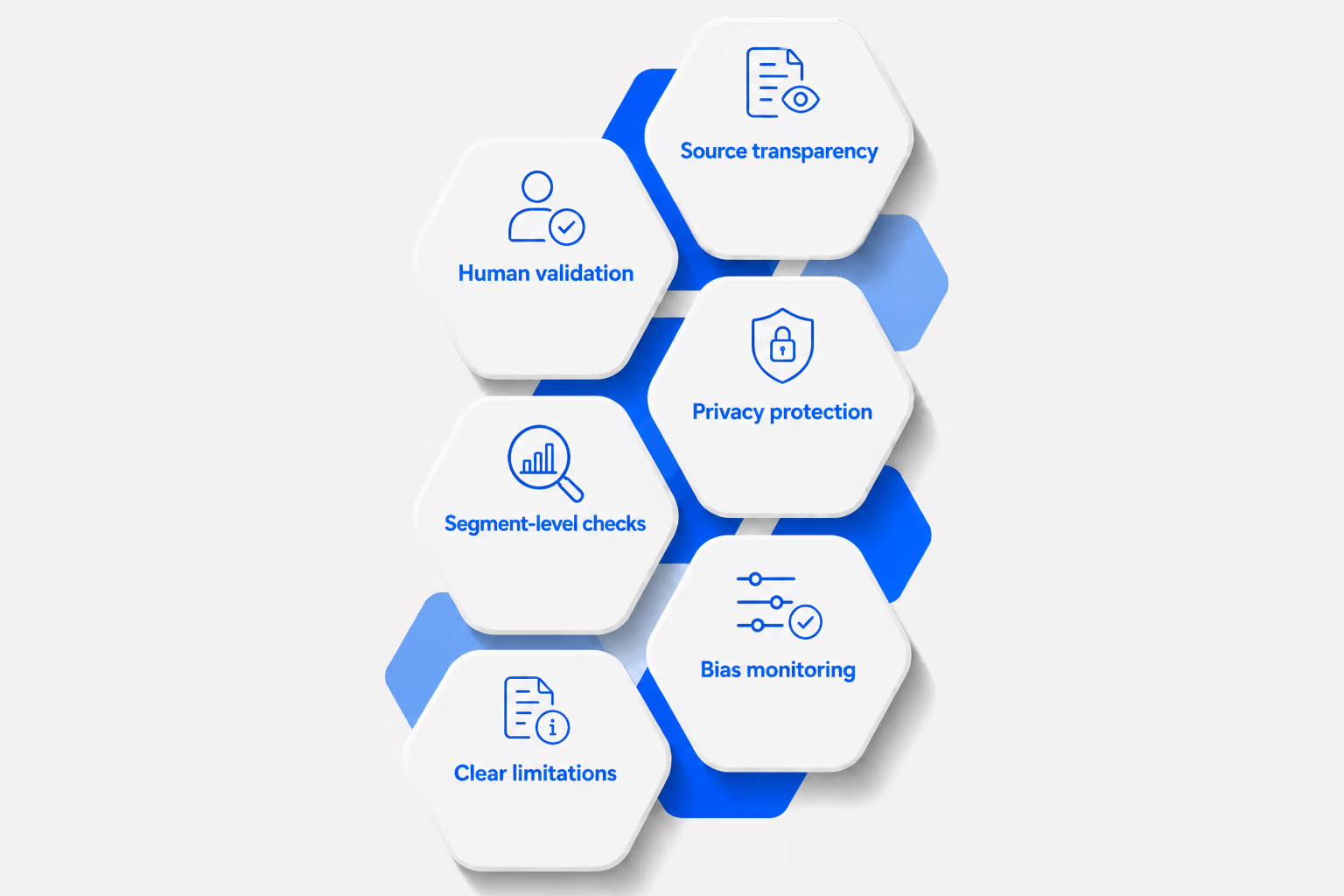
AI qualitative research needs guardrails because polished outputs can hide weak analysis.
Strong guardrails include:
- Human review: researchers should validate themes, sentiment, and summaries.
- Quote traceability: insights should link back to real respondent language.
- Cultural context checks: local language, dialect, and social norms must be considered.
- Segment-level reading: findings should not blend very different audiences into one average.
- Bias monitoring: models should be checked for overreading dominant languages or frequent terms.
- Clear limitations: teams should state what the sample can and cannot prove.
These guardrails help ensure AI does not turn qualitative work into shallow automation.
Final Thoughts
The future of AI qualitative research GCC is not about replacing moderators, analysts, or researchers. It is about giving them sharper tools to process more human evidence without losing the meaning inside it.
The best qualitative research still depends on curiosity, cultural sensitivity, good questioning, and careful interpretation. AI can accelerate the work, but it cannot replace the judgment needed to understand why people hesitate, soften criticism, change tone, or choose one brand over another.
This is why platforms and research systems such as BioBrain Insights are becoming relevant in modern insight workflows. By connecting InstaQual, Web Intelligence, RRR-style filtering, AI-assisted open-text analysis, and expert validation, they reflect where qualitative research is heading: faster analysis, richer context, and more defensible insights for teams that cannot afford to miss what consumers are really saying.

.avif)