TL;DR
- Brand tracking measures brand health over time. It monitors how consumer awareness, perception, consideration, and preference evolve across research periods.
- Key metrics reveal competitive positioning. Brand awareness, associations, perceived quality, preference, and loyalty indicators help identify strengths, weaknesses, and perception gaps.
- Consistent research delivers meaningful insights. Continuous, monthly, or quarterly brand tracking studies help businesses identify trends, evaluate changes, and understand shifting consumer expectations.
- Better insights drive stronger brand strategies. Tracking consumer perceptions helps brands refine positioning, identify growth opportunities, and make informed, research-backed decisions.
What Is Brand Tracking?
Brand tracking is a continuous or periodically repeated market research process that measures how consumers recognize, perceive, consider, and engage with a brand over time. It helps businesses understand whether their brand is becoming more familiar, relevant, trusted, or preferred within its competitive market.
Unlike a one-time brand perception survey, brand tracking collects comparable data across multiple research periods, commonly called waves. Each wave measures consistent indicators, enabling researchers to distinguish short-term changes from longer-term patterns.
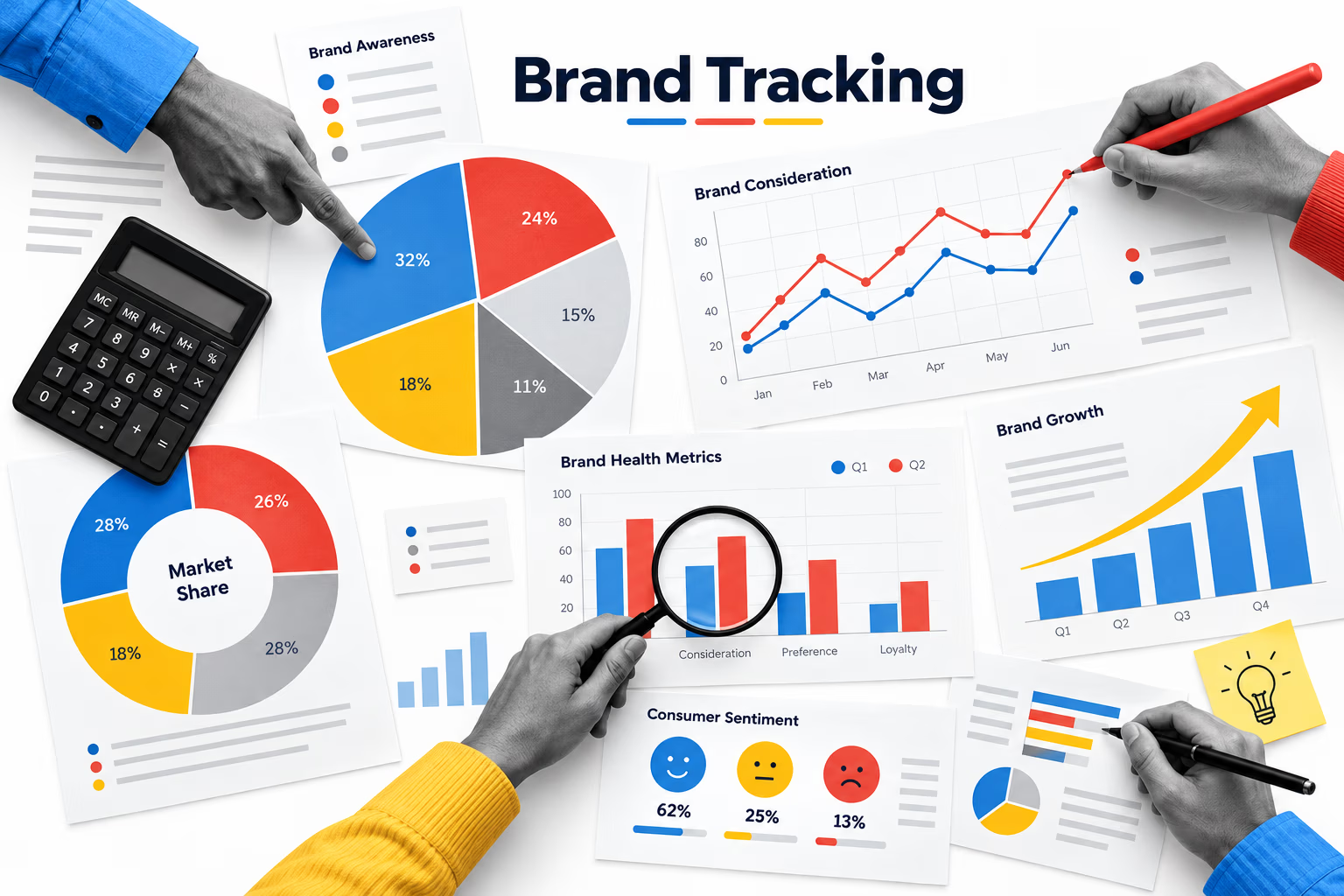
A brand tracking study typically examines awareness, consideration, preference, brand associations, perceived quality, and customer experience. These measures provide a broader picture of brand health than sales figures or advertising reach alone.
For example, a brand may experience increasing awareness without a corresponding improvement in consideration. This suggests consumers are recognizing the brand but may not yet view it as a relevant purchasing option.
That difference is precisely what tracking research is designed to reveal.
Brand tracking measures how a brand's position in consumers' minds changes, while helping businesses understand the factors behind those changes.
Why Brand Tracking Matters for Businesses
Brand performance cannot be fully understood through immediate commercial outcomes.
Sales may increase because of discounts, wider distribution, or seasonal demand, even when consumers' underlying perceptions remain unchanged.
Conversely, a brand may strengthen its reputation and consideration before those improvements become visible in sales.
Brand health tracking provides valuable context for interpreting these developments.
Identify Changes in Consumer Perception
Consumer expectations, category needs, and competitive perceptions evolve.
Tracking research helps identify whether a brand is gaining relevance, losing differentiation, or becoming associated with attributes that influence purchase decisions.
Benchmark Against Competitors
Brand performance becomes more meaningful when evaluated against relevant competitors.
An increase in awareness may appear encouraging, but if competitors experience substantially stronger growth, the brand's relative position may still be weakening.
Evaluate Long-Term Brand Investments
Advertising, positioning, sponsorships, and brand-building initiatives can influence perceptions over time.
Repeated measurement helps businesses observe changes following these activities, although tracking data alone cannot establish that a particular initiative caused them.
Identify Growth Opportunities
Segment-level analysis can reveal audiences where awareness is high but consideration remains low, or where satisfaction is strong but familiarity is limited.
These patterns help teams prioritize their next research questions and strategic decisions.
Key Brand Tracking Metrics to Measure
A useful brand tracking survey should focus on indicators that reflect the brand's objectives and customers' decision-making process.
Not every brand requires the same measures. A new entrant may prioritize awareness and relevance, while an established brand may focus on preference, differentiation, and loyalty.
These indicators serve different purposes.
Awareness establishes whether consumers know the brand exists. Consideration indicates whether it enters their set of potential choices. Preference reveals comparative appeal, while brand associations explain the meanings influencing those judgments.
Established measurement frameworks, including YouGov's BrandIndex, also distinguish between brand perception, media awareness, and purchase-related indicators.
A comprehensive tracker should preserve those distinctions rather than compress every measure into a single score.
How Does a Brand Tracking Study Work?
A reliable tracking program requires consistent research design, representative audience coverage, and disciplined analysis.
1. Define the Research Objectives
Begin with the questions the business needs to answer.
These might include whether awareness is growing, whether a repositioning strategy is changing perceptions, or why consideration differs across customer segments.
Objectives determine which metrics, competitors, and consumer groups should be included.
2. Identify the Target Audience
Recruit respondents who represent the relevant market, including potential customers rather than exclusively existing buyers.
For consumer brands, sampling may account for age, region, category participation, and other relevant characteristics.
For B2B brands, researchers may need to consider industry, company size, purchasing responsibility, and decision-making roles.
Audience consistency is essential: a change in respondent composition can create an apparent movement in brand metrics even when underlying perceptions have not changed.
3. Design a Consistent Questionnaire
Create standardized questions covering awareness, consideration, brand imagery, purchase behavior, and relevant category attitudes.
Keep core wording, response scales, and measurement definitions consistent across waves.
Additional diagnostic questions can be introduced when needed, but changes to established measures should be documented to protect comparability.
4. Conduct Research Across Multiple Waves
Collect responses on a recurring schedule.
Many trackers use repeated cross-sectional samples, meaning different respondents are recruited from the same target population during each wave.
Others use longitudinal panels that follow the same individuals over time.
Both approaches can be useful, but they answer somewhat different questions and require appropriate controls for sampling and respondent participation.
5. Validate and Analyze the Results
Review response quality, sample composition, incomplete answers, suspicious patterns, and inconsistencies before reporting.
Apply weighting where methodologically justified, then evaluate differences across time, audience segments, and competitors.
The final output should explain what changed, how confident researchers are in the finding, and which business decisions the evidence supports.
How Often Should Brands Conduct Tracking Research?
There is no universal tracking frequency.
The right cadence depends on category dynamics, marketing activity, audience availability, research budget, and how quickly meaningful changes are expected.
More frequent data collection does not automatically produce better insights.
For narrow audiences, collecting enough reliable responses may be more valuable than publishing frequent results based on very small samples.
Consistency, sample quality, and decision relevance matter more than tracking frequency alone.
How to Analyze Brand Health Results
Effective analysis goes beyond reporting whether individual scores increased or decreased.
Researchers must establish whether a change is meaningful, where it occurred, and what may explain it.
Examine Trends Over Time
Compare the same metric across multiple waves rather than interpreting two isolated data points.
For instance, an awareness score increasing from 40% to 44% represents a rise of 4 percentage points, not 4%.
However, the difference should be assessed against sampling uncertainty, survey design, and possible changes in audience composition.
Evaluate Competitive Movement
A brand's performance may improve while competitors improve faster.
Tracking competitors using comparable metrics helps distinguish broader category shifts from brand-specific developments.
Analyze Audience Segments
Overall results can conceal important differences.
For example, younger consumers may report increasing consideration while older consumers show declining familiarity.
Segment analysis helps identify where changes are concentrated, provided sufficient sample sizes support those comparisons.
Investigate the Reasons Behind Changes
Quantitative scores explain the scale and direction of movement, but often provide limited explanation of its causes.
Open-ended feedback, brand association questions, and additional research can clarify whether shifts reflect pricing concerns, brand messaging, experience, or competitive developments.
This combination produces more actionable insights than reporting headline percentages alone.
Brand Tracking vs. Brand Lift and Social Listening
These research approaches are related but serve different purposes.
- Brand tracking measures recurring consumer perceptions and brand health indicators across a broader market.
- Brand lift research evaluates the incremental effect of a particular campaign or advertising exposure, commonly by comparing exposed and suitable control groups.
- Social listening examines online conversations, themes, and sentiment associated with a brand or category.
- Social listening can reveal emerging complaints or public discussions, but social media contributors are not necessarily representative of the target market.
Similarly, website visits, search volume, and engagement provide useful behavioral signals but cannot independently establish how many consumers know, trust, or prefer a brand.
These approaches are most valuable when used to answer complementary research questions rather than treated as interchangeable measures.
Practical Examples of Brand Tracking
1. Consumer Goods Brand
A beverage company launches a new positioning campaign emphasizing healthier ingredients.
Its tracker measures awareness, association with health-related benefits, consideration, and competitor perceptions across multiple waves.
If awareness rises but the intended association remains unchanged, researchers can investigate whether consumers understand the new message.
The result provides direction for refining communication rather than assuming campaign success from exposure alone.
2. B2B Technology Brand
A technology provider wants to improve its position among enterprise decision-makers.
It tracks familiarity, perceived expertise, trust, consideration, and purchase barriers among relevant professional audiences.
The results may reveal strong credibility among existing customers but limited awareness among prospective buyers.
That finding suggests a different strategic priority from improving satisfaction among current accounts.
Both examples are illustrative and demonstrate how tracking supports specific business decisions.
Common Mistakes That Weaken Tracking Studies
One major mistake is changing survey wording, response scales, or sampling methods between waves without accounting for the impact.
These changes can make differences in methodology appear to be changes in consumer opinion.
Another mistake is measuring too many metrics without identifying which ones support important business decisions.
Overly complex questionnaires increase respondent burden and can reduce data quality.
Researchers should also avoid treating small movements as definitive improvements, relying only on existing customers, or comparing brands that compete in materially different contexts.
Finally, a tracking study should not become a reporting exercise disconnected from action.
The most useful findings identify what deserves further investigation, what may require intervention, and what should continue to be monitored.
Turning Brand Insights Into Business Decisions
A strong brand tracking program connects measurement with strategic priorities.
- Awareness is improving but consideration remains weak, teams may investigate perceived relevance, differentiation, or purchase barriers.
- Preference declines despite stable awareness, they may examine competitor positioning, value perceptions, or customer expectations.
- Positive brand associations strengthen over several waves, the business can assess whether those developments align with its intended positioning.
The goal is not to react to every fluctuation. It is to identify consistent patterns supported by credible evidence.
Final Thoughts
Brand tracking helps businesses understand how consumer perceptions evolve, where their brand stands against competitors, and which changes deserve attention.
Its value comes from consistent measurement, reliable respondents, meaningful comparisons, and interpretation that connects findings to decisions.
BioBrain Insights supports market research teams with questionnaire automation, data-quality validation, and research analysis workflows that help turn recurring consumer feedback into clearer insights.
Because building a stronger brand starts with understanding how people perceive it and recognizing when those perceptions begin to change.