UAE brands do not have a data shortage. They have a meaning shortage.
Most businesses today can track sales, traffic, conversions, inventory, app usage, campaign spend, customer complaints, payment behavior, and operational performance. The problem is not whether data exists. The problem is whether that data explains what customers actually want, why they are changing, and what the brand should do next.
This is where the difference between business intelligence UAE and consumer intelligence becomes critical.
Business intelligence tells a company what is happening inside the business. Consumer intelligence explains what is happening inside the market. One shows performance. The other reveals meaning.
And in a market as fast-moving as the UAE, brands need both.
What Business Intelligence Actually Does
Business intelligence, or BI, helps companies collect, organize, visualize, and monitor internal business data. It usually pulls information from systems such as CRM, ERP, ecommerce platforms, finance tools, sales dashboards, call center systems, and marketing platforms.
A BI dashboard can show:
- Monthly sales performance
- Product-level revenue
- Customer acquisition cost
- Campaign ROI
- Inventory movement
- Conversion rates
- Customer churn
- Regional store performance
- Operational delays
- Finance and margin trends
For UAE businesses, BI is powerful because the market is digitally advanced, competitive, and performance-driven. Retailers, banks, telecoms, real estate companies, hospitality brands, healthcare providers, and ecommerce platforms all need fast access to operational numbers.
The UAE’s wider analytics environment is expanding quickly. The Middle East data analytics market reached USD 4.07 billion in 2025 and is expected to hit USD 25.77 billion by 2034, growing at a 22.75% CAGR. This growth is being driven by cloud adoption, smart city use cases, healthcare analytics, and enterprise-level decision systems.
That makes data analytics UAE a serious business priority. But analytics alone does not guarantee insight.
A dashboard can show that customer churn increased by 9%. It may not explain whether the reason is price sensitivity, poor service recovery, weak onboarding, competitor promotions, changing expectations, or declining trust.
That is where BI reaches its limit.
What Consumer Intelligence Adds
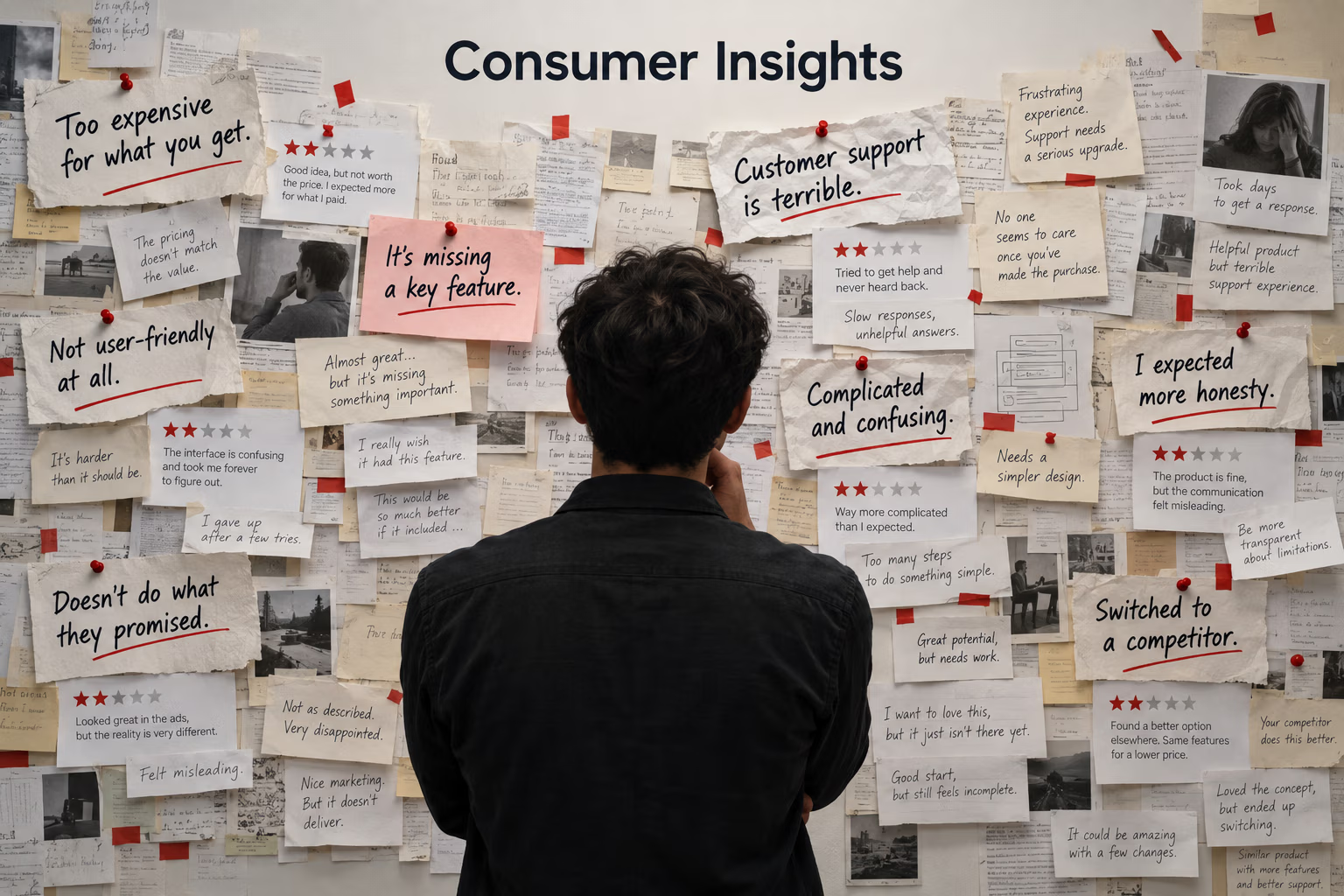
Consumer intelligence focuses on the external and human side of the market. It helps brands understand customer needs, motivations, emotions, expectations, complaints, choices, and behavior signals.
It works with data such as:
- Survey responses
- Open-ended feedback
- Customer reviews
- Social conversations
- Search trends
- Product complaints
- Interview transcripts
- Focus group inputs
- App store reviews
- Support tickets
- Public web signals
- Competitor conversations
- Creator and influencer content
While business intelligence tracks business performance, consumer intelligence explains consumer behavior.
For example, BI may show that online sales are declining in a specific product category. Consumer intelligence may reveal that customers are comparing prices more aggressively, delaying purchases for sale days, complaining about delivery reliability, or shifting to marketplace platforms because of trust and availability.
This distinction matters deeply in the UAE because consumer behavior is not simple. The market includes Emirati nationals, Arab expats, South Asian consumers, Western residents, tourists, high-net-worth shoppers, digital-first Gen Z audiences, value-conscious households, and premium service users.
A single BI report can easily flatten all of that complexity into averages. Strong customer insights UAE systems help brands see the difference between audience groups, not just the total number.
Why UAE Brands Cannot Depend Only on Dashboards
Dashboards are useful, but they can create a dangerous illusion: the feeling that because something is measurable, it is understood.
A business intelligence dashboard may show that a brand’s Net Promoter Score dropped from 48 to 39. But the number itself is not the insight. The insight is what sits behind the drop.
Was the problem caused by delayed delivery? Poor staff communication? Pricing confusion? Product quality? A digital journey issue? Unclear return policies? Expectations shaped by another brand?
Without consumer intelligence, teams often react to symptoms instead of causes.
This is especially important in UAE customer experience. Recent ServiceNow research reported that UAE consumers lose more than 83 million hours annually dealing with slow service and inefficient support systems. The same research found that poor service costs each consumer an average of 10.8 hours per year.
BI can tell a service team how many tickets were opened and how long they took to close. Consumer intelligence can explain the emotional cost of that experience: frustration, repetition, lack of empathy, low confidence, and switching risk.
That is the difference between measuring service and understanding the customer.
Business Intelligence Answers “What Happened?”
Business intelligence is strongest when the question is operational.
It answers:
- What sold?
- Which channel performed?
- Where did revenue increase?
- Which campaign delivered ROI?
- Which region underperformed?
- How many customers churned?
- What is the cost trend?
- Which product has stock pressure?
These answers are essential for management reporting, forecasting, planning, budgeting, and performance control.
In a strong UAE business, BI gives leadership a single source of truth. It reduces confusion, improves visibility, and helps teams act faster on internal performance data.
For example, a hospitality group can use BI to track occupancy, average daily rate, booking sources, guest segments, and seasonal demand. A retailer can track SKU performance, store footfall, margin, online conversion, and campaign efficiency.
But BI usually looks backward or at current performance. It tells teams what the business recorded.
It does not always explain what customers are beginning to feel.
Consumer Intelligence Answers “Why Is It Happening?”
Consumer intelligence is strongest when the question is behavioral.
It answers:
- Why are customers switching?
- What frustrates them?
- What do they expect next?
- Which emotions are rising?
- What are competitors being praised for?
- Which unmet needs are emerging?
- What language do customers use?
- Which trust signals influence purchase?
- What is changing before it appears in sales?
This is where market analytics middle east is evolving. The strongest brands are no longer satisfied with static reporting. They want to connect internal metrics with external signals.
For example, a UAE bank may see higher app drop-offs in BI. Consumer intelligence may show that customers are confused by verification steps, anxious about security, annoyed by chatbot loops, or comparing digital banking experiences with fintech apps.
A beauty brand may see strong awareness but weak conversion. Consumer intelligence may show that customers like the product concept but distrust claims, prefer creator-led proof, or feel the price is too high without visible value.
These are not dashboard problems. They are meaning problems.
Where Predictive Analytics Fits
Predictive analytics UAE is becoming more important because brands want to move from reporting to anticipation. Instead of waiting for churn, demand shifts, or complaints to become visible, predictive analytics helps identify likely future patterns.
Predictive analytics can support:
- Churn prediction
- Demand forecasting
- Customer lifetime value modeling
- Campaign response prediction
- Price sensitivity analysis
- Service escalation risk
- Product demand planning
- Market trend detection
- Audience segmentation
Globally, the predictive analytics market is expected to grow by USD 75.1 billion between 2026 and 2030, expanding at a 33.6% CAGR. The UAE is listed among key countries in this growth landscape, reflecting the wider regional shift toward forward-looking analytics.
But prediction must be grounded in consumer reality.
A predictive model may identify customers likely to churn. But unless the brand understands the reason behind churn, it may respond with the wrong action. A discount may not solve a trust issue. Faster delivery may not solve poor product clarity. More advertising may not fix weak customer experience.
Prediction becomes stronger when business intelligence and consumer intelligence work together.
BI identifies the pattern. Consumer intelligence explains the cause. Predictive analytics estimates where the pattern may go next.
UAE Consumers Are Becoming Harder to Read
UAE consumers are not moving in one direction. They are becoming more digital, more selective, more value-aware, and more experience-driven at the same time.
Mastercard’s 2025 Consumer Shopper Snapshot found that 80% of UAE consumers prioritize value for money when choosing gifts, while 74% time purchases around major sale days. The same research showed an omnichannel pattern: 90% turn to physical stores, 87% buy from ecommerce marketplaces, and 61% use AI to help with holiday purchases.
This is exactly why brands need both BI and consumer intelligence.
BI may show that sale-day revenue increased. Consumer intelligence explains whether customers are becoming more intentional, more price-sensitive, more AI-assisted, or more dependent on marketplace comparisons.
BI may show that physical stores still matter. Consumer intelligence explains why: trust, trial, immediacy, service, social experience, or premium reassurance.
The UAE customer journey is no longer linear. It moves across search, social platforms, creators, reviews, marketplaces, malls, apps, customer support, and peer recommendations.
A brand that only reads sales data is seeing the final action, not the full journey.
AI Adoption Raises the Standard
AI is changing both business intelligence and consumer intelligence.
Microsoft’s AI Economy Institute reported that the UAE ranked first globally in AI adoption, with 64% of the working-age population using AI by the end of 2025, up from 59.4% earlier in the year.
This matters because AI is no longer just a backend tool. It is now part of how employees work, how consumers search, how shoppers compare options, and how businesses analyze decisions.
In business intelligence, AI can automate anomaly detection, forecasting, dashboard summaries, and performance alerts.
In consumer intelligence, AI can analyze open-ended responses, detect themes, classify sentiment, summarize interviews, process reviews, monitor web signals, and identify emerging audience patterns.
But the risk is clear: faster analysis can also produce faster misunderstanding if context is weak.
That is why modern insight systems need human validation, source traceability, multilingual interpretation, and research discipline. AI can process signals at scale, but insight still needs judgment.
The Real Need: Connected Intelligence
The future is not business intelligence versus consumer intelligence. UAE brands need connected intelligence.
That means linking internal performance data with external consumer signals.
For example:
- Sales decline + review complaints = product or service issue
- High traffic + low conversion = trust, price, or UX problem
- Strong awareness + weak loyalty = unmet expectations
- High support volume + negative sentiment = CX friction
- Campaign reach + weak engagement = message mismatch
- Repeat purchase drop + competitor praise = switching risk
This is where intelligence-led platforms become more relevant. The best systems help teams connect structured data, unstructured feedback, sentiment, behavioral signals, and market movement into one decision layer.
A dashboard may say, “conversion dropped.”
Connected intelligence asks, “conversion dropped among whom, after which interaction, because of what concern, and what should be tested next?”
That is the question UAE brands actually need to answer.
What Brands Should Use Business Intelligence For
Business intelligence should remain the foundation for internal clarity.
UAE brands should use BI to:
- Monitor business health
- Track performance across channels
- Compare regions, stores, products, and teams
- Identify operational bottlenecks
- Measure marketing efficiency
- Improve financial planning
- Support leadership reporting
- Build performance accountability
BI is essential when the business needs accuracy, structure, and speed in reporting.
Without BI, companies operate with fragmented numbers and delayed decision-making.
But BI should not be expected to explain every customer behavior. It is strongest when measuring business outcomes, not decoding human motivation.
What Brands Should Use Consumer Intelligence For
Consumer intelligence should guide strategy, product decisions, customer experience, communication, and market understanding.
UAE brands should use consumer intelligence to:
- Understand customer needs and barriers
- Track sentiment across channels
- Decode open-ended feedback
- Identify emerging trends
- Compare competitor perception
- Improve product positioning
- Strengthen customer experience
- Build better segmentation
- Test pricing and messaging
- Detect early switching signals
This is especially valuable for brands in retail, fintech, healthcare, tourism, real estate, telecom, luxury, education, and consumer services.
These sectors do not compete only on price or availability. They compete on trust, speed, experience, relevance, and emotional confidence.
Consumer intelligence helps explain those softer signals before they become hard business losses.
What Brands Actually Need in the UAE
UAE brands do not need another isolated dashboard. They need an insight system that can connect performance, behavior, sentiment, and market signals.
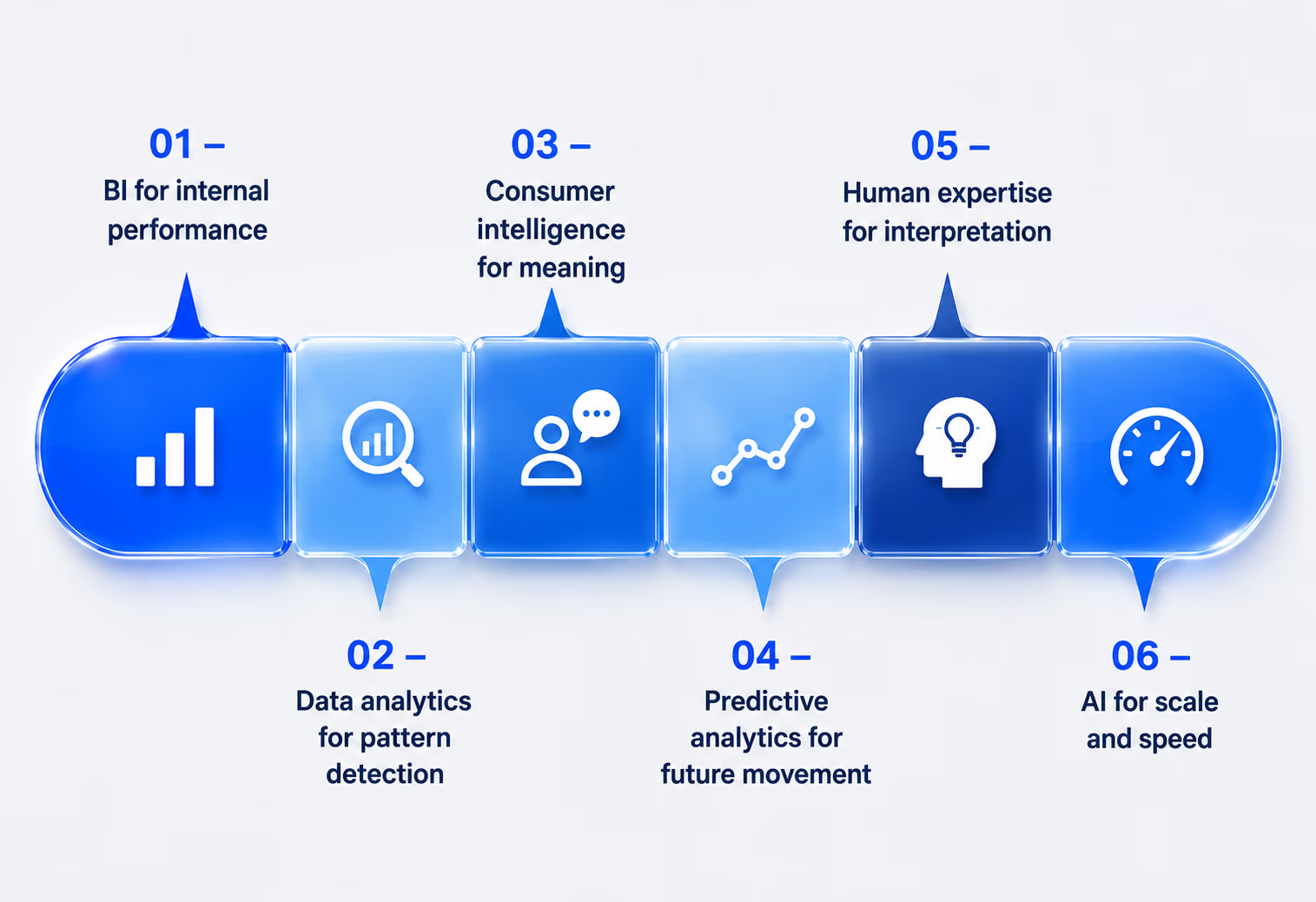
The ideal model looks like this:
- BI for internal performance
- Data analytics for pattern detection
- Consumer intelligence for meaning
- Predictive analytics for future movement
- Human expertise for interpretation
- AI for scale and speed
This combination helps teams move faster while improving reliability, context, and decision quality.
In the UAE, where consumer expectations shift quickly and competition is intense, the winning brands will not be the ones with the most data. They will be the ones that understand which signals matter, why they matter, and what action should follow.
Final Thoughts
Business intelligence shows how the business is performing. Consumer intelligence shows why customers are responding the way they are. Predictive analytics helps estimate what may happen next. Together, they give UAE brands a sharper way to act in a market shaped by digital behavior, AI adoption, value sensitivity, service expectations, and fast-moving competition.
This is where platforms like BioBrain Insights become relevant for modern insight teams - helping connect customer feedback, open-text analysis, web signals, sentiment intelligence, research automation, and expert validation into faster, clearer, and more decision-ready intelligence for UAE brands.
.avif)