
Consumer markets in the GCC are moving faster than many traditional research cycles can handle. The UAE, Saudi Arabia, Qatar, Kuwait, Bahrain, and Oman are being shaped by digital adoption, tourism growth, ecommerce expansion, retail modernization, younger populations, and rising expectations around convenience, personalization, and trust. For modern brands, this makes consumer insights middle east work more important than ever. It is no longer enough to know what people bought last quarter. Brands need to understand what consumers are feeling, comparing, questioning, avoiding, and expecting next.
At its core, consumer insight is the process of turning customer data, behavior, opinions, emotions, and market signals into business understanding. It is not just “data.” It is the interpretation of data in a way that explains why consumers act the way they do and what brands should do in response.
In GCC markets, this distinction matters. A brand may know that app downloads increased, but insight explains why conversion stayed low. A retailer may know sales dropped in one category, but insight reveals whether the cause was price, product fit, competitor promotions, poor experience, or changing lifestyle priorities.
What Are Consumer Insights?
Consumer insights are evidence-based explanations of consumer behavior. They connect what people do with why they do it.
Strong consumer insights usually answer questions such as:
- What motivates purchase or rejection?
- Which needs are unmet?
- What does the customer value most?
- Which experience gaps create frustration?
This is where consumer intelligence GCC becomes valuable. Consumer intelligence combines multiple inputs: surveys, interviews, social media, reviews, search behavior, ecommerce data, customer service logs, transaction patterns, and market context. When these signals are analyzed together, brands can make stronger decisions about product design, pricing, customer experience, communication, and expansion.
Why GCC Consumer Behavior Needs Local Understanding
The GCC is often discussed as one region, but it is not one consumer market. Each country has a different population mix, income structure, retail maturity, tourism profile, and digital behavior.
Consumer behavior UAE is heavily shaped by diversity, tourism, premium retail, service and digital. UAE has extremely high digital reach: with 11.3 million internet users and 99.0% internet penetration, with 12.5 million social media user identities.
Saudi Arabia, meanwhile, is changing at enormous scale. Consumer behavior Saudi Arabia is being influenced by Vision 2030 reforms, entertainment expansion, tourism growth, rising local pride, women’s workforce participation, youth culture, ecommerce, and new retail formats.
These numbers show why digital signals matter, but they also show why digital data needs interpretation. High internet penetration does not mean all consumers behave the same way. A Saudi Gen Z shopper in Riyadh, a high-income Emirati family in Abu Dhabi, a South Asian expat household in Dubai, and a Qatari luxury buyer may all use digital platforms, but their motivations and decision rules can be completely different.
Regional Behavior Shifts Reshaping GCC Consumers
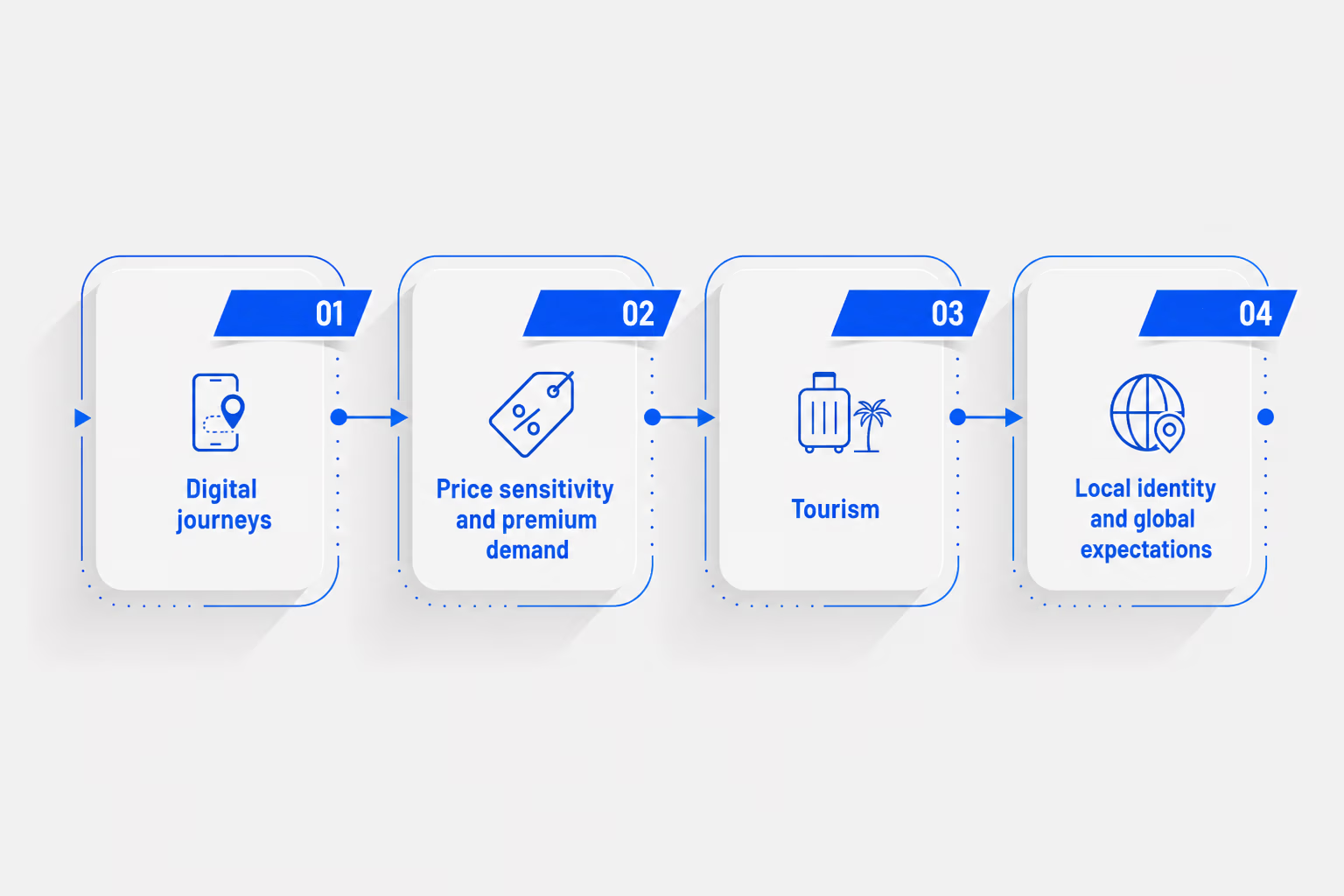
Several major behavior shifts are changing how brands should understand the Gulf consumer.
1. Digital journeys are now normal
Consumers across the GCC increasingly discover, compare, review, and buy through digital channels. This does not only affect ecommerce brands. It affects banks, clinics, restaurants, real estate developers, education providers, telecom companies, luxury retailers, and tourism brands.
The UAE’s ecommerce market is projected to reach $17.2 billion by 2027, with an estimated 8.4% CAGR from 2023 to 2027, according to Dubai Chambers. Saudi Arabia’s ecommerce market is also expected to expand, with P&S Intelligence estimating it at $16.3 billion in 2025 and forecasting it to reach $36.6 billion by 2032, growing at 12.3% during 2026–2032.
For brands, this means customer insights UAE and Saudi consumer intelligence must include digital behavior, not just stated preferences. Reviews, search behavior, delivery complaints, abandoned carts, influencer conversations, and app feedback are now part of the insight system.
2. Price sensitivity and premium demand are coexisting
A common mistake is assuming GCC consumers are only premium buyers. The reality is more layered. Premium price exists, especially in luxury, hospitality, beauty, wellness, real estate, and high-end services. But value-seeking behavior is also rising, particularly as consumers compare online, use promotions, and switch between brands.
Gulf consumers as more digitally savvy, more price sensitive, and more socially aware, with these shifts continuing beyond the pandemic period.
This creates a strategic challenge. Brands cannot assume that higher income always means lower price sensitivity. Many affluent consumers still compare value, service quality, exclusivity, convenience, and trust before choosing.
3. Tourism is changing consumer signals
Tourism is a major driver of behavior in the UAE and Saudi Arabia. Dubai International Airport handled 95.2 million passengers in 2025 and was forecast to handle nearly 99.5 million passengers in 2026. Dubai also recorded 19.6 million international overnight visitors in 2025.
Saudi Arabia is also pushing aggressively into tourism. Reuters reported that Saudi Arabia is targeting 150 million tourists annually by 2030, including at least 50 million international visitors, while also increasing focus on more affordable mid-market tourism options.
This matters for consumer insights because tourist behavior can distort local demand signals. A luxury retail spike in Dubai may reflect visitor spending, not resident loyalty. A hospitality trend in Saudi may reflect new domestic tourism patterns, not only international demand. Brands must separate resident, tourist, expat, and national segments to understand real opportunity.
4. Local identity and global expectations are rising together
GCC consumers increasingly expect global standards but still respond to local relevance. This is especially visible in Saudi Arabia, where national transformation, local pride, entertainment, culture, and retail modernization are shaping new consumer expectations.
At the same time, consumers in the UAE are exposed to global brands, international lifestyles, and world-class service benchmarks. This creates a dual expectation: brands must feel modern and globally competitive, but also locally aware and culturally intelligent.
That is why generic regional messaging often underperforms. Consumer intelligence must uncover which claims feel credible, which values matter locally, and which experiences feel authentic rather than imported.
UAE Consumer Trends: Convenience, Diversity, and Trust
The UAE is one of the most complex consumer markets in the region because of its demographic mix. Expatriates outnumber nationals, and more than 200 nationalities live and work in the country, according to the UAE Ministry of Foreign Affairs.
This makes consumer behavior UAE difficult to measure through broad averages. For brands, the UAE is not one audience. It includes Emiratis, Arab expats, South Asian expats, Western expats, tourists, high-net-worth residents, blue-collar workers, entrepreneurs, families, and transient professionals.
Key UAE insight priorities include:
- Segmenting nationals, expats, tourists, and high-income residents separately
- Tracking service expectations across retail, hospitality, healthcare, banking, and delivery
- Understanding mobile-first purchase journeys
- Monitoring review platforms and social sentiment
- Testing whether premium positioning is supported by real trust and experience
For customer insights UAE, the biggest risk is blended data. If a study mixes resident and tourist behavior, or combines high-income and value-driven segments without separation, the insight may look clean but mislead business decisions.
Saudi Consumer Trends: Scale, Youth, and Transformation
Saudi Arabia is the largest consumer market in the GCC and one of the most strategically important. Its transformation is changing how people spend leisure time, interact with brands, use digital channels, and respond to local experiences.
Saudi Arabia’s consumer landscape is shaped by:
- A large and digitally connected population
- Strong social media usage
- Growth in entertainment and tourism
- Rising ecommerce adoption
- New retail and lifestyle destinations
- Increasing importance of local relevance
- Younger consumers influencing category demand
Saudi Arabia’s 2026 budget also reflects continued investment in priority sectors such as industry, logistics, tourism, and technology, as part of the next phase of Vision 2030 transformation.
For brands, consumer behavior Saudi Arabia requires more than translating UAE strategies into Arabic. Riyadh, Jeddah, Dammam, and smaller cities can show different patterns in media behavior, family decision-making, price perception, and category adoption.
How Brands Should Track Consumer Signals
Modern brands need to move from one-time studies to continuous signal tracking.
The most useful consumer insight systems combine:
- Primary research: surveys, interviews, focus groups, diaries, and ethnography
- Digital intelligence: social listening, search trends, forums, reviews, and creator content
- Customer experience data: complaints, NPS, app feedback, call center logs, and store audits
- Commercial data: sales, repeat purchase, basket size, churn, and conversion
- Cultural context: language, local norms, lifestyle shifts, and policy or tourism changes
This is how brands separate noise from insight. A spike in negative comments may not mean a product is failing. It may reflect a delivery issue, campaign mismatch, influencer controversy, or customer expectation gap. Similarly, high awareness does not always mean strong trust or purchase intent.
Good consumer intelligence asks: What signal is changing, who is driving it, and what decision should change because of it?
AI and Sentiment Intelligence in GCC Consumer Research
AI is becoming increasingly useful in consumer intelligence GCC because the region produces large volumes of multilingual, fast-moving, unstructured data. Reviews, social posts, survey open-ends, call transcripts, and customer complaints can reveal powerful patterns if analyzed properly.
AI and sentiment intelligence can help brands:
- Detect emerging themes faster
- Classify sentiment across large text volumes
- Identify emotional drivers behind complaints or loyalty
- Track competitor perception
- Summarize open-ended responses
- Monitor category shifts across digital platforms
- Compare signals across UAE, Saudi Arabia, and wider GCC markets
But AI should not be treated as a shortcut to truth. Sentiment can be difficult in Arabic, English, Hinglish, Arabizi, Urdu, Malayalam, and mixed-language conversations. Sarcasm, cultural expressions, brand slang, and context can confuse automated models.
This is why AI-led consumer insight needs human interpretation. Automation can process signals quickly, but a researcher still needs to validate meaning, remove irrelevant data, and connect the finding to real business action.
Final Thoughts
The future of consumer insights middle east is not about collecting more data. It is about turning the right signals into sharper intelligence.
GCC consumers are digital, diverse, value-aware, and increasingly selective. This is why intelligence-led platforms like BioBrain Insights are emerging, combining AI-powered analysis with human research expertise to deliver faster, reliable, and expert-backed insights.
The strongest brands will move beyond generic regional assumptions and continuously track what consumers say, feel, and do. In modern GCC markets, insight is no longer just a report - it is a living system for staying ahead of change.
.avif)