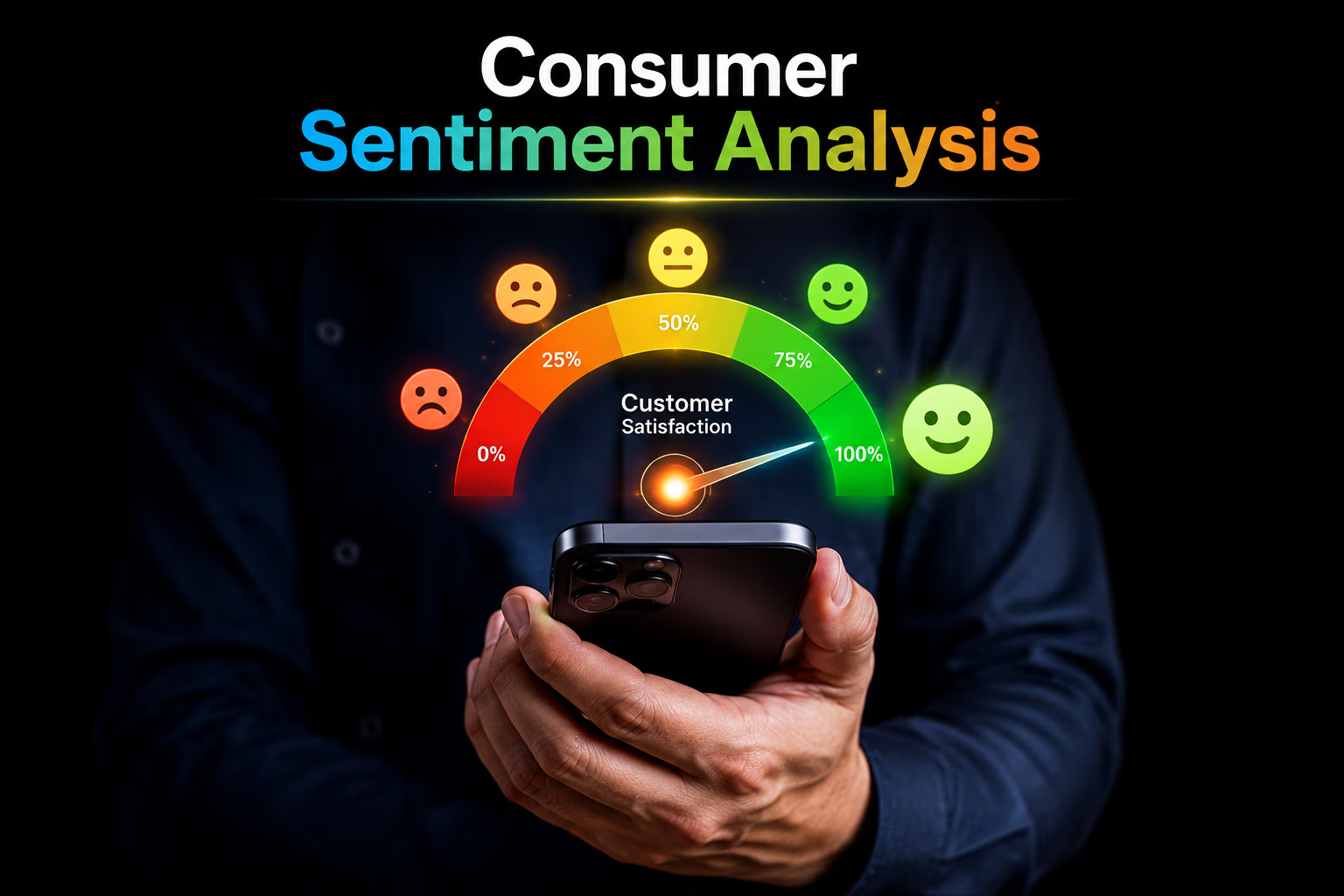
What Is Customer Sentiment Analysis?
Customer sentiment analysis is the process of identifying how consumers feel, think, react, and express opinion across feedback channels. It goes beyond simple satisfaction scores by reading emotion, tone, frustration, trust, hesitation, urgency, and intent.
In GCC markets, sentiment can come from structured and unstructured sources such as:
- Customer surveys
- Open-ended survey responses
- App reviews
- Social media comments
- E-commerce ratings
- Call-center transcripts
- Customer support tickets
- WhatsApp-style service interactions
- Public web feedback
The key point: customer sentiment analysis does not replace traditional surveys. It strengthens them by explaining why consumers feel the way they do.
Why Sentiment Analysis Matters in GCC Markets
GCC consumers are highly digital, multilingual, and service-sensitive. Their feedback is no longer limited to formal surveys. They discuss brands across social platforms, service channels, app stores, review pages, banking support systems, retail apps, delivery platforms, and public web spaces.
This makes sentiment analysis GCC important because brands need to understand:
- What consumers are praising
- What they are complaining about
- Which issues are growing faster
- Which complaints are isolated
- Which signals affect trust
- Which concerns can impact loyalty
- Which themes are linked to consumer confidence GCC
Use fresh numeric data here:
- Saudi Arabia’s official Consumer Confidence Index reached about 114 points in September 2025, based on a survey of around 6,000 individuals.
- Ipsos reported Saudi Arabia’s consumer sentiment index at 70.8 in May 2026.
- The UAE had 11.3 million internet users at the end of 2025, with 99% internet penetration.
- The UAE had 11.3 million social media user identities in January 2025, equal to 100% of the population at that time.
These numbers show why traditional survey-only research is no longer enough. GCC consumers are constantly generating digital signals, and brands need systems that can read those signals with context.
Customer Sentiment Analysis vs Traditional Surveys
Traditional surveys are useful because they provide structured answers. They help measure CSAT, NPS, CES, brand awareness, purchase intent, product preference, and satisfaction.
But surveys often ask consumers to choose from fixed options. Sentiment analysis captures what customers say when they are not limited by predefined choices.
A survey may show that satisfaction dropped from 82% to 76%. Sentiment analysis can explain whether that drop was caused by:
- Delivery delays
- Poor support response
- App crashes
- Pricing concerns
- Fraud anxiety
- Product quality issues
- Confusing policies
- Weak service recovery
- Negative online conversation
This is the core difference: surveys measure the score; sentiment analysis explains the story behind the score.
Traditional Surveys vs Customer Sentiment Analysis
The Benefits of Customer Sentiment Analysis
This section should be practical and business-focused.
Customer sentiment analysis helps GCC brands:
- Detect customer frustration earlier - Negative feedback often appears in comments, reviews, support tickets, and social posts before it affects formal survey scores.
- Explain why satisfaction scores move - A score tells teams what changed. Sentiment analysis shows what caused the movement.
- Improve customer experience decisions - Themes such as slow service, confusing app flows, unclear pricing, and weak follow-up can be linked to specific operational fixes.
- Track trust and risk signals - In sectors like banking, healthcare, insurance, and e-commerce, trust language is critical. PwC’s 2025 GCC Banking Sentiment Index highlights consumer demand for improved service, reliable digital experiences, and stronger fraud prevention.
- Identify churn and loyalty drivers - Repeated negative sentiment around unresolved complaints may indicate churn risk. Positive sentiment around trust, convenience, and fast resolution may indicate loyalty potential.
- Support campaign and product messaging - Sentiment analysis helps brands see whether consumers find a message credible, relevant, confusing, or culturally misaligned.
How to Measure Customer Sentiment
This section should answer direct search intent clearly.
Customer sentiment can be measured through a combination of structured, semi-structured, and unstructured data sources.
1. Survey comments
Use open-ended questions after CSAT, NPS, CES, or product ratings.
2. Customer reviews
Analyze comments from Google Reviews, app stores, e-commerce platforms, food delivery apps, hospitality sites, and category-specific review channels.
3. Social and public web feedback
Track public consumer discussions, brand mentions, complaint patterns, and emerging themes through Web Intelligence.
4. Support tickets and service chats
Classify complaints by topic, urgency, sentiment, and resolution status.
5. Call-center transcripts
Analyze recurring pain points, escalation language, and service recovery outcomes.
6. App feedback
Measure sentiment around login issues, payment failures, crashes, navigation, and digital trust.
7. AI-based classification
Use AI to classify large feedback volumes into sentiment polarity, theme, urgency, and intent.
8. Human validation
Validate Arabic, English, dialect, mixed-language, and culturally sensitive responses before making decisions.
How to Measure Customer Sentiment Across Feedback Sources
Key Customer Sentiment Metrics Brands Should Track
This section should make the blog useful for research, CX, and marketing teams.
Sentiment polarity
Positive, negative, or neutral direction.
Sentiment intensity
How strong the emotion is. A mildly negative comment and an angry complaint should not be treated the same.
Theme frequency
How often topics such as delivery, pricing, app issues, support, trust, or quality appear.
Complaint velocity
How quickly a negative theme is rising across channels.
Trust language
Mentions of safety, fraud, privacy, authenticity, reliability, and confidence.
Resolution sentiment
How customers feel after a complaint is handled.
Segment sentiment
Sentiment by market, city, audience type, language, customer tier, or product group.
Channel sentiment
Whether sentiment differs across surveys, reviews, social platforms, app stores, and support channels.
Key Customer Sentiment Metrics to Track
Customer Sentiment Analysis Use Cases in GCC
This section should make the blog more concrete and less generic.
Banking and financial services
Track fraud concerns, digital banking reliability, service delays, transaction failures, fee complaints, onboarding friction, and trust.
Retail and e-commerce
Analyze delivery delays, return experiences, stock issues, product quality, promotion clarity, price fairness, and seller trust.
Healthcare
Measure patient sentiment around waiting time, doctor communication, billing clarity, appointment access, follow-up, and care quality.
Hospitality and tourism
Track check-in experience, cleanliness, service tone, booking clarity, food quality, transport friction, and cultural comfort.
Telecom
Monitor network quality, billing disputes, customer care response, plan clarity, and service reliability.
Public services
Analyze citizen and resident feedback around digital portals, service access, clarity, processing time, and support quality.
Sentiment Analysis Use Cases by Industry
Role of AI in Consumer Sentiment Analysis
AI helps sentiment analysis scale. It can process large volumes of text, detect recurring themes, classify emotion, compare feedback sources, summarize comments, and identify sudden changes in consumer mood.
This is where AI consumer intelligence UAE becomes especially relevant. In a highly digital market like the UAE, brands can use AI to analyze feedback across app reviews, surveys, online comments, customer service data, and public web signals.
But AI should not be used without quality controls. It can misread sarcasm, Arabic dialects, mixed-language text, emojis, and indirect complaints. It can also inflate small issues if duplicate or low-quality comments are not filtered.
A strong AI-led sentiment system should include:
- Language detection
- Duplicate removal
- Theme classification
- Sentiment scoring
- Human validation
- Source weighting
- Market-level comparison
- Confidence scoring
Why Multilingual Sentiment Analysis Is Critical in GCC
GCC sentiment is not always written in clean English or formal Arabic. Consumers may use Arabic, English, Gulf dialects, Arabizi, emojis, abbreviations, and mixed-language phrasing.
This matters because meaning can change quickly across languages.
A polite Arabic phrase may contain dissatisfaction. A short English comment from a second-language speaker may carry strong frustration. A mixed Arabic-English complaint may use one language for the issue and another for emotional emphasis.
For sentiment analysis GCC, multilingual accuracy is not a technical detail. It is a research quality requirement.
Teams should analyze original language wherever possible, validate translated outputs, and avoid treating all comments as if they follow the same communication style.
How to Build a Reliable Sentiment Analysis System
This section should be a practical framework.
Step 1: Define the business question
Do not start with “track sentiment.” Start with the decision the brand needs to make.
Step 2: Map feedback sources
Identify where customers actually speak: surveys, reviews, support, social platforms, app stores, and Web Intelligence sources.
Step 3: Build a sentiment taxonomy
Group comments into practical themes such as trust, delivery, pricing, app friction, service tone, product quality, and complaint resolution.
Step 4: Separate emotion from topic
A comment about delivery can be mildly negative, strongly negative, or urgent. Topic and emotion should be coded separately.
Step 5: Validate multilingual feedback
Check Arabic, English, dialect, and mixed-language responses with human review.
Step 6: Track recurrence and velocity
A single complaint may not matter. A repeated complaint that grows quickly does.
Step 7: Connect findings to actions
The output should show what changed, where it changed, why it matters, and what teams should do next.
Building a Reliable Sentiment Analysis System
Mistakes to Avoid in Customer Sentiment Analysis
This section should strengthen the informational value of the blog.
Common mistakes include:
1. Treating sentiment as only positive, negative, or neutral
This misses intensity, context, sarcasm, and mixed emotion.
2. Ignoring Arabic nuance
Arabic dialects, indirect phrasing, and cultural expressions can change meaning.
3. Overreacting to one viral spike
A spike may be loud but temporary. Recurrence matters more than noise.
4. Mixing poor-quality data with real feedback
Bots, duplicates, spam, and low-quality comments can distort findings.
5. Using generic AI models without localization
Models that do not understand GCC language and culture may misread sentiment.
6. Reporting dashboards without decisions
A dashboard is not insight unless it helps teams act.
The Future of Sentiment Analysis in GCC
The next stage of sentiment analysis in GCC will combine structured surveys, Web Intelligence, AI classification, open-ended feedback, CX analytics, and human interpretation.
Traditional surveys will still matter. But brands will increasingly use sentiment analysis to understand what consumers say between surveys, after service interactions, during campaigns, and across public digital channels.
The strongest research systems will not only measure satisfaction. They will track confidence, trust, friction, urgency, and behavior signals together.
Final Thoughts
Consumer sentiment analysis in GCC markets is not about replacing traditional surveys. It is about completing the picture that surveys alone cannot show.
Surveys capture structured answers. Sentiment analysis captures emotion, language, complaint patterns, trust signals, and the reasons behind consumer behavior.
For GCC brands, the opportunity is to combine consumer confidence GCC indicators, multilingual feedback, AI consumer intelligence UAE, Web Intelligence, and customer experience data into one clearer view of the market.
The strongest insight will come from understanding both what consumers select and what they say when no answer option is enough.

.avif)