
Why Fraud Detection Has Become Critical in Market Research
As online market research continues to scale, the challenge is no longer simply collecting responses - it is determining whether those responses are authentic, reliable, and methodologically defensible.
Researchers today operate in an environment where fraudulent participation has become increasingly sophisticated. Online surveys are now vulnerable to:
- duplicate respondents
- automated bots
- click farms
- AI-generated answers
- false qualification behavior
- low-engagement participation
This has transformed fraud detection from a secondary quality-control task into a core operational requirement within market research workflows.
In recent years, industry discussions around data quality have intensified significantly. Researchers across practitioner communities increasingly describe fraud detection as one of the most difficult aspects of modern survey research.
The reason is simple:
Fraudulent responses no longer appear obviously fraudulent.
Many now resemble legitimate participant behavior until deeper validation reveals inconsistencies.
What Makes Fraudulent Survey Responses Difficult to Detect?
Historically, poor-quality responses were easier to identify.
Researchers could often spot fraud through:
- unrealistic completion speed
- repeated answer patterns
- obvious demographic inconsistencies
But modern fraud behavior has evolved rapidly.
Today’s fraudulent participants may:
- intentionally slow response times
- vary response patterns
- use multiple devices and IPs
- generate polished open-ended responses using AI
As a result, detecting fraudulent survey responses increasingly requires layered validation systems rather than isolated quality checks.
The Most Common Fraud Detection Techniques Used in Market Research
Modern research teams use multiple validation methods simultaneously to improve research reliability.
1. Attention Checks
Attention checks remain one of the most widely used fraud detection techniques in online surveys.
These questions are designed to evaluate whether respondents are:
- reading questions carefully
- following instructions
- engaging meaningfully with the survey
Example:
“Please select ‘Strongly Agree’ for this question.”
Respondents who fail attention checks may be flagged for low-quality participation.
However, attention checks alone are no longer sufficient because many fraudulent participants now anticipate them.
2. Speeding Detection
Completion speed is another important signal used in survey validation.
Researchers monitor whether participants complete surveys:
- significantly faster than expected
- unrealistically quickly for the question complexity
- with minimal engagement time
For example, a 20-minute survey completed in 3 minutes may indicate:
- bot activity
- random answering
- low-attention participation
Industry studies suggest that speeding remains one of the most common indicators of low-quality survey data.
3. Straightlining Analysis
Straightlining occurs when respondents repeatedly select the same answer across multiple questions without meaningful consideration.
Researchers analyze:
- repetitive response patterns
- lack of answer variability
- matrix question consistency
This helps identify disengaged or automated participation behavior.
Straightlining is particularly problematic in long quantitative surveys where respondent fatigue increases over time.
4. Duplicate IP and Device Detection
Researchers frequently monitor:
- duplicate IP addresses
- browser fingerprints
- device IDs
- geographic inconsistencies
to identify duplicate or coordinated participation.
This is especially important in online panel environments where respondents may attempt to complete the same study multiple times using alternate identities.
However, modern fraud participants increasingly use:
- VPNs
- virtual machines
- device rotation
making duplicate detection more difficult than before.
5. Open-Ended Response Evaluation
One of the fastest-growing fraud detection areas involves qualitative response analysis.
Researchers increasingly review open-ended survey responses for:
- repetitive phrasing
- semantic inconsistency
- low contextual depth
- AI-generated language patterns
As generative AI tools become more accessible, open-ended fraud detection has become significantly more important.
Responses may now appear:
- grammatically correct
- structurally polished
- contextually coherent
while still lacking genuine human authenticity.
This has created a major challenge for traditional quality-control systems.
6. Behavioral Analysis
Modern fraud detection increasingly relies on behavioral signals rather than isolated validation questions.
Researchers analyze patterns such as:
- mouse movement behavior
- click timing
- scrolling activity
- hesitation patterns
- interaction consistency
Behavioral analysis helps identify participation patterns that appear automated or artificially optimized.
This approach is becoming increasingly important as fraud participants learn to bypass traditional validation checks.
7. Logic and Consistency Checks
Researchers also validate whether responses remain logically consistent throughout the survey.
For example:
- age and work experience alignment
- household size consistency
- contradictory demographic information
Inconsistencies across responses often indicate fraudulent or low-attention participation.
These checks are especially important in longitudinal studies and segmentation research.
Why Layered Validation Is Becoming Essential
One major shift in modern market research is the move away from isolated fraud checks toward layered validation systems.
Historically, many surveys relied on:
- one or two attention checks
- simple speeding thresholds
- basic duplicate monitoring
Today, that approach is often insufficient.
Fraud detection increasingly requires combining multiple validation layers simultaneously, including:
- behavioral analysis
- contextual validation
- device verification
- qualitative signal review
- response consistency modeling
This layered approach improves the ability to identify low-authenticity participation before it compromises research reliability.
The Growing Challenge of AI-Generated Responses
One of the most significant developments in survey fraud is the rise of generative AI participation.
Researchers increasingly report concerns around respondents using AI tools to:
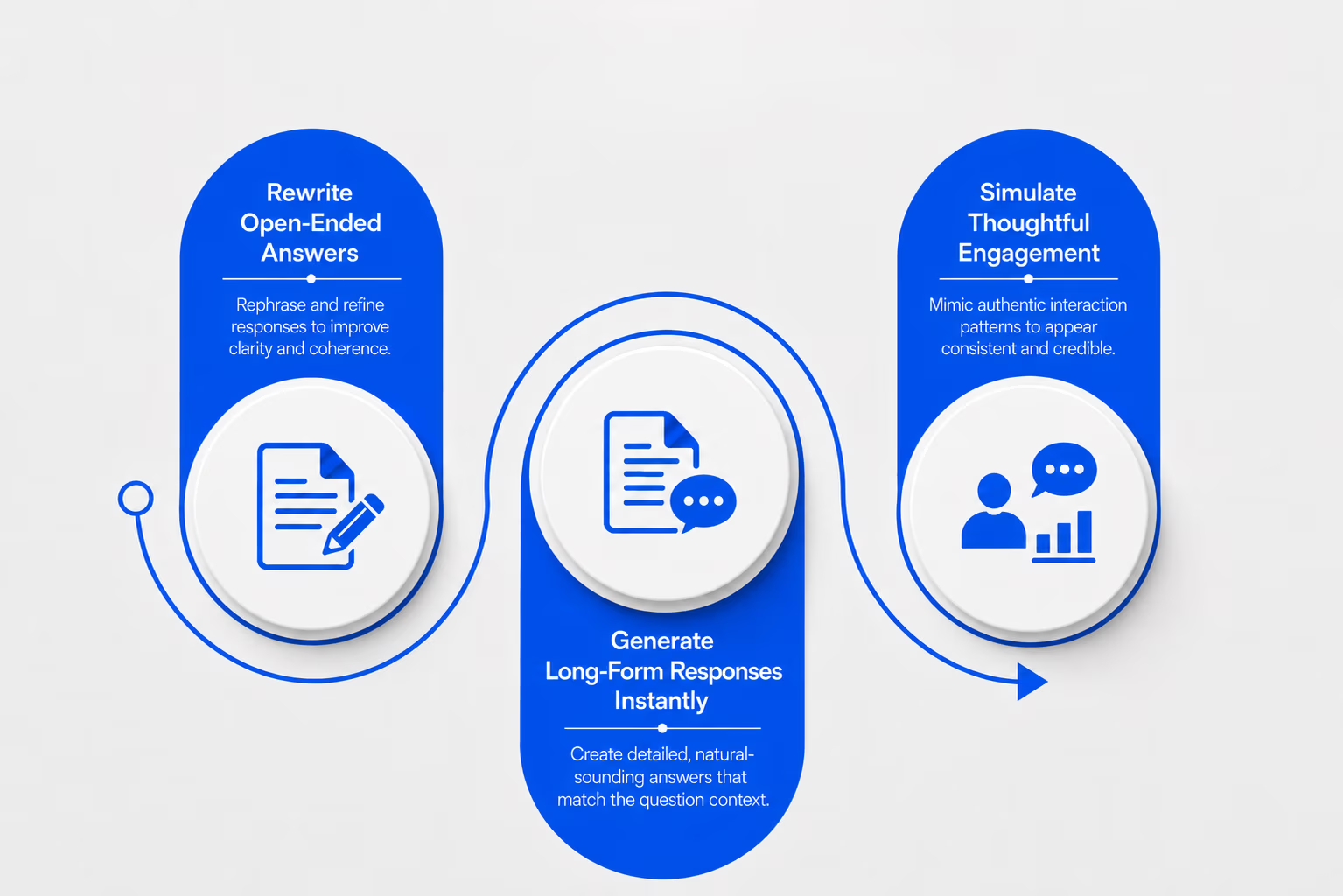
- rewrite open-ended answers
- generate long-form responses instantly
- simulate thoughtful engagement
Unlike traditional bot responses, AI-generated participation may appear highly articulate and difficult to identify manually.
This has shifted fraud detection toward deeper evaluation of:
- linguistic variation
- contextual alignment
- semantic authenticity
- response originality
Industry discussions increasingly acknowledge that AI-generated survey fraud represents one of the fastest-growing challenges in modern research operations.
The Operational Impact of Fraud Detection
Fraud detection significantly affects research workflows.
Research teams now dedicate increasing resources to:
- validation processes
- manual response review
- data cleaning
- respondent replacement
- quality assurance workflows
This operational burden can lead to:
- extended fieldwork timelines
- reduced usable sample sizes
- higher validation costs
- slower project completion
Researchers working with low-incidence audiences often face difficult trade-offs between:
- maintaining strict quality thresholds
- achieving recruitment targets
This tension has become increasingly common across online research environments.
The Shift Toward Intelligence-Led Validation Systems
As fraud detection becomes more complex, research teams are increasingly adopting intelligence-powered validation approaches.
Platforms such as BioBrain Insights reflect this transition through intelligence-powered and professionally-led research systems designed to evaluate data reliability beyond traditional validation checks.
Approaches such as the RRR Framework - focused on recency, relevance, and resonance - help filter meaningful and contextually aligned signals from large datasets, while systems such as InstaQual support deeper evaluation of interviews, discussions, and open-ended responses through structured transcript analysis and contextual validation.
This reflects a broader industry shift toward continuously evaluating the reliability and integrity of research data throughout the workflow itself.
The Future of Fraud Detection in Market Research
Fraud detection is expected to become one of the defining capabilities of modern market research operations.
Over the next few years, research teams are likely to adopt:
- AI-assisted fraud detection systems
- real-time behavioral scoring
- advanced identity verification
- contextual language validation
- integrated reliability pipelines
At the same time, fraudulent participation itself will continue evolving.
As AI-generated responses become more sophisticated, research quality will increasingly depend on the ability to validate authenticity—not just collect responses at scale.
The future of market research will likely be shaped by systems capable of continuously assessing:
- data integrity
- respondent authenticity
- methodological reliability
- contextual consistency
throughout the research process itself.
Conclusion
Detecting fraudulent survey responses has become one of the most important operational challenges in modern market research.
From speeding and straightlining to AI-generated participation and coordinated fraud networks, fraudulent behavior is becoming increasingly sophisticated and difficult to identify through traditional methods alone.
As online research environments continue evolving, effective fraud detection will increasingly depend on layered validation systems that combine behavioral analysis, contextual evaluation, structured workflows, and intelligence-led quality control approaches capable of protecting research reliability at scale.