Understanding Fraud Responses in Modern Research
Market research depends on one core principle: the responses collected during a study should accurately represent real participants, genuine opinions, and authentic behaviors.
However, maintaining that standard has become increasingly difficult.
As online research continues to expand globally, fraud responses have emerged as one of the most significant challenges affecting modern market research operations. Researchers today are dealing with growing volumes of:
- duplicate participants
- bots
- AI-generated responses
- click farm activity
- false qualification behavior
- low-engagement participation
These issues are no longer isolated incidents. Across surveys, online panels, qualitative interviews, and digital communities, research teams are increasingly questioning the reliability of collected responses and the integrity of research samples.
In simple terms:
Fraud responses refer to any survey or research participation that is deceptive, invalid, low-authenticity, or intentionally manipulative in a way that compromises research quality.
Why Fraud Responses Are Increasing
The rise of online research has made participation faster, more scalable, and more accessible. At the same time, it has also created stronger incentives for fraudulent participation.
Today, respondents can participate in research through:
- survey panels
- reward-based survey platforms
- participant marketplaces
- online communities
- referral systems
Where incentives exist, fraudulent behavior often follows.
Researchers across industry discussions increasingly describe online fraud as one of the fastest-growing operational risks in market research.
Several factors are contributing to this increase:
- global access to online surveys
- automated participation tools
- AI-generated text systems
- growing panel overlap
- professional survey-taking networks
The result is an environment where fraudulent responses are becoming more sophisticated and significantly harder to detect.
Common Types of Fraud Responses
Fraud responses can appear in many forms depending on the type of study and research methodology being used.
1. Duplicate Respondents
Duplicate participation occurs when the same individual attempts to complete a study multiple times using:
- alternate email addresses
- multiple devices
- VPNs
- fake identities
This artificially inflates participation and compromises sample integrity.
In online research environments, duplicate participation remains one of the most common forms of survey fraud.
2. Bot Responses
Bots are automated systems designed to complete surveys without genuine human engagement.
These responses may:
- complete surveys extremely quickly
- generate repetitive answers
- bypass basic validation checks
Modern bots are becoming increasingly advanced, especially when combined with AI-generated language systems.
3. AI-Generated Survey Responses
One of the newest challenges in market research involves respondents using generative AI tools to answer open-ended survey questions.
AI-generated responses can appear:
- grammatically polished
- contextually coherent
- well-structured
But they may lack genuine human experience or authentic perspective.
This creates a major challenge for researchers because fraudulent responses no longer appear obviously fake.
4. Click Farms and Incentive Farming
Click farms involve groups of individuals completing large numbers of surveys for compensation.
Researchers across industry discussions frequently describe:
- coordinated survey-taking behavior
- shared device usage
- large-scale incentive farming operations
These participants prioritize survey volume and payout frequency over thoughtful participation.
5. Straightlining and Speeding
Some respondents attempt to complete studies as quickly as possible by:
- selecting identical answers repeatedly
- rushing through questions
- avoiding engagement with survey content
These responses reduce the reliability and consistency of collected data.
6. False Qualification
Participants may intentionally provide inaccurate information about:
- demographics
- profession
- location
- income
- industry experience
to qualify for higher-paying studies.
This becomes especially problematic in niche audience recruitment and specialized B2B research.
Why Fraud Responses Matter in Market Research
Fraud responses affect far more than individual survey results.
They compromise:
- sample quality
- analytical reliability
- statistical validity
- respondent authenticity
- research confidence
Poor-quality participation introduces noise into datasets, making it harder for researchers to identify genuine patterns and meaningful insights.
In quantitative research, fraudulent participation can distort:
- segmentation models
- trend analysis
- cross-tabulation
- statistical relationships
In qualitative studies, fraudulent participants can introduce artificial narratives and misleading discussion themes.
Over time, this reduces confidence in research findings themselves.
How Fraud Responses Affect Research Operations
The operational consequences of fraud responses are becoming increasingly significant across the research industry.
Research teams now spend substantial time on:
- respondent validation
- data cleaning
- sample replacement
- manual review processes
- quality assurance workflows
Fraud responses can also lead to:
- delayed fieldwork
- reduced usable sample sizes
- extended project timelines
- increased validation costs
Researchers working with low-incidence audiences often face difficult trade-offs between maintaining sample quality and achieving recruitment targets.
Why Fraud Detection Is Becoming More Difficult
Historically, researchers relied on relatively simple validation methods such as:
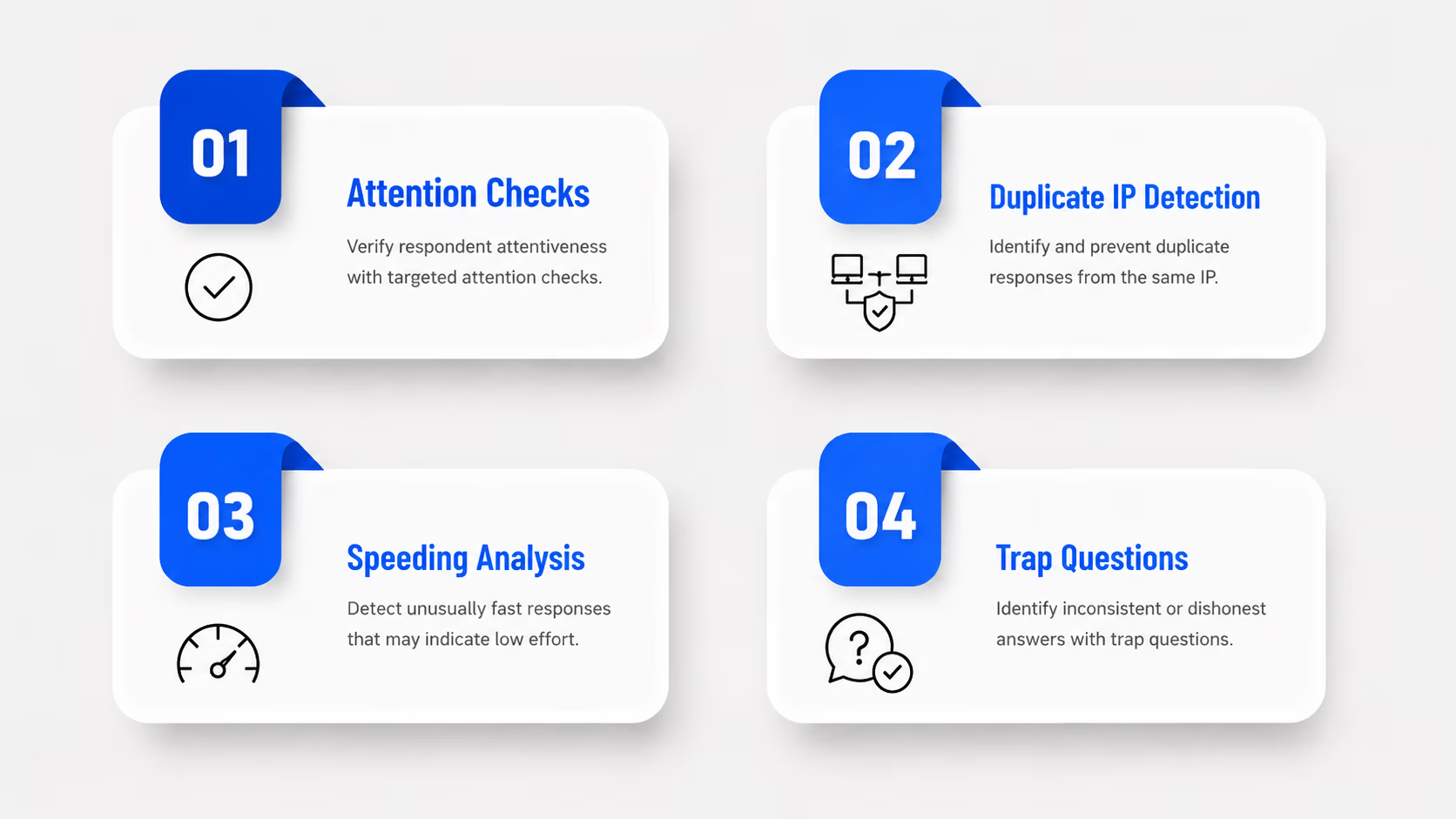
- attention checks
- duplicate IP detection
- speeding analysis
- trap questions
While these methods remain important, fraudulent participation behavior has become significantly more sophisticated.
Modern fraud participants often adapt to validation systems by:
- intentionally slowing response speed
- varying answer patterns
- rotating devices and locations
- using AI-generated open-ended responses
As a result, many fraudulent responses now resemble legitimate participant behavior until deeper validation reveals inconsistencies.
This has made traditional fraud detection approaches increasingly insufficient on their own.
How Researchers Detect Fraud Responses
To improve research reliability, teams are adopting layered validation systems that combine multiple quality control techniques.
Attention and Logic Checks
Surveys increasingly include embedded validation logic to identify inconsistent or careless participation behavior.
These checks evaluate whether respondents:
- follow instructions carefully
- maintain consistency across responses
- contradict earlier answers
Device and IP Verification
Researchers monitor:
- duplicate IP addresses
- device fingerprints
- suspicious geographic activity
- browser inconsistencies
to identify potentially fraudulent participation.
Behavioral Analysis
Modern systems increasingly analyze participation behavior such as:
- completion timing
- click patterns
- response variation
- open-ended engagement depth
This helps identify low-authenticity or automated responses.
Open-Ended Response Evaluation
Researchers now frequently review qualitative responses for:
- repetitive phrasing
- AI-generated language structures
- semantic inconsistency
- low contextual depth
This has become increasingly important as AI-generated participation rises.
The Rise of Intelligence-Led Validation
As fraud becomes more advanced, research teams are moving toward more integrated validation systems.
Modern research environments increasingly combine:
- behavioral analysis
- structured validation workflows
- contextual consistency checks
- qualitative signal analysis
- respondent verification systems
The focus is shifting away from identifying only obvious fraud and toward evaluating the overall authenticity and reliability of participation behavior.
Approaches that prioritize signals based on:
- recency
- relevance
- resonance
can help researchers distinguish meaningful participant input from artificial or low-authenticity responses.
At the same time, advances in qualitative analysis now allow researchers to process open-ended responses, interviews, and discussions at scale—making it easier to identify inconsistencies across language, tone, repetition, and context.
The Future of Fraud Responses in Market Research
Fraud responses are expected to remain one of the defining operational challenges in market research over the coming years.
As generative AI systems become more sophisticated, fraudulent participation behavior will likely become:
- harder to identify
- more scalable
- more realistic in appearance
This means research quality will increasingly depend on:
- stronger validation systems
- layered fraud detection workflows
- behavioral analysis
- intelligent quality control frameworks
The challenge for modern research is no longer simply collecting responses at scale. It is ensuring that those responses remain authentic, reliable, and methodologically defensible throughout the research process.
Conclusion
Fraud responses in market research are no longer isolated cases of poor-quality participation. They now represent a broader challenge around maintaining data authenticity, methodological rigor, and confidence in research outputs across increasingly digital research environments.
As fraudulent behavior becomes more sophisticated, research teams are moving toward more structured validation approaches combining behavioral analysis, contextual consistency checks, and layered quality control workflows. Platforms such as BioBrain Insights reflect this shift through intelligence-powered and professionally-led research systems designed to evaluate data reliability beyond traditional checks.
Approaches like the RRR Framework and qualitative intelligence systems such as InstaQual support deeper validation of research signals, helping research teams assess the authenticity, relevance, and integrity of responses more effectively throughout the workflow.