
In fast-moving GCC markets, assumptions can become expensive quickly. Consumer behavior is being reshaped by digital adoption, tourism, retail expansion, premium services, and younger audiences across the UAE, Saudi Arabia, Qatar, Kuwait, Bahrain, and Oman.
This is where primary market research becomes critical. The GCC is not one uniform audience. In the UAE, expatriates outnumber nationals across 200+ nationalities, which means research screeners must clearly separate Emiratis/Saudi nationals from major expat segments such as Western, Arab, and South Asian audiences. Without this separation, blended data can easily distort results for luxury, policy, heritage, retail, or service-led brands.
At the same time, digital reach is massive. Markets like the UAE show 99.0% internet penetration, with over 11.3 million active users, making digital primary research highly scalable when surveys are mobile-friendly, well-screened, and properly validated.
By using the right market research methods, GCC brands can collect first-hand evidence from customers, shoppers, users, patients, employees, or business decision-makers and understand what people need, why they behave the way they do, what prevents them from buying, and which decisions can improve market entry, product design, pricing, communication, and customer experience.
What Is Primary Market Research?
Primary market research is research that collects original data directly from the target audience for a specific business question. Unlike secondary research, which uses existing sources such as reports, articles, government data, or industry publications, primary research is designed around a company’s own objective.
For example, a retail brand entering Saudi Arabia may want to know whether shoppers prefer premium packaging or value bundles. A fintech company in Dubai may want to understand why users abandon onboarding. A healthcare provider in Qatar may want to explore patient expectations around digital consultations.
In each case, the brand needs direct evidence from the relevant audience.
Primary research helps answer questions such as:
- Who is the target customer?
- What do they need, prefer, or reject?
- Why do they choose one brand over another?
- What price feels acceptable?
This makes primary research one of the most important methods of market research for brands operating in complex, diverse, and competitive GCC markets.
Why Primary Research Matters for GCC Brands
The GCC is not one uniform market. It is a region of nearly 62 million people, with major differences in population size, income levels, languages, nationalities, and consumer expectations across Saudi Arabia, UAE, Kuwait, Qatar, Oman, and Bahrain.
That is why one-size-fits-all research rarely works. A campaign tested in Dubai may not reflect family-led decision-making in Kuwait. A premium offer that works in Abu Dhabi may need different pricing cues in Oman. A fintech product adopted by young users in Riyadh may require stronger trust signals for older audiences elsewhere.
Primary market research helps brands capture these local differences before they invest in launches, campaigns, pricing, or expansion.
It is especially useful for:
- Testing new products or services across different GCC audiences
- Understanding pricing, packaging, and value perception
- Improving customer experience across stores, apps, delivery, and support
- Measuring brand trust, awareness, and perception
- Testing ads, claims, and campaign concepts for cultural relevance
- Studying niche groups such as luxury buyers, tourists, HNWIs, patients, or Gen Z consumers
A good market researcher does more than collect responses. They design the right sample, choose the right methodology, reduce bias, validate answers, and turn findings into clear business direction.
Key Primary Market Research Methods
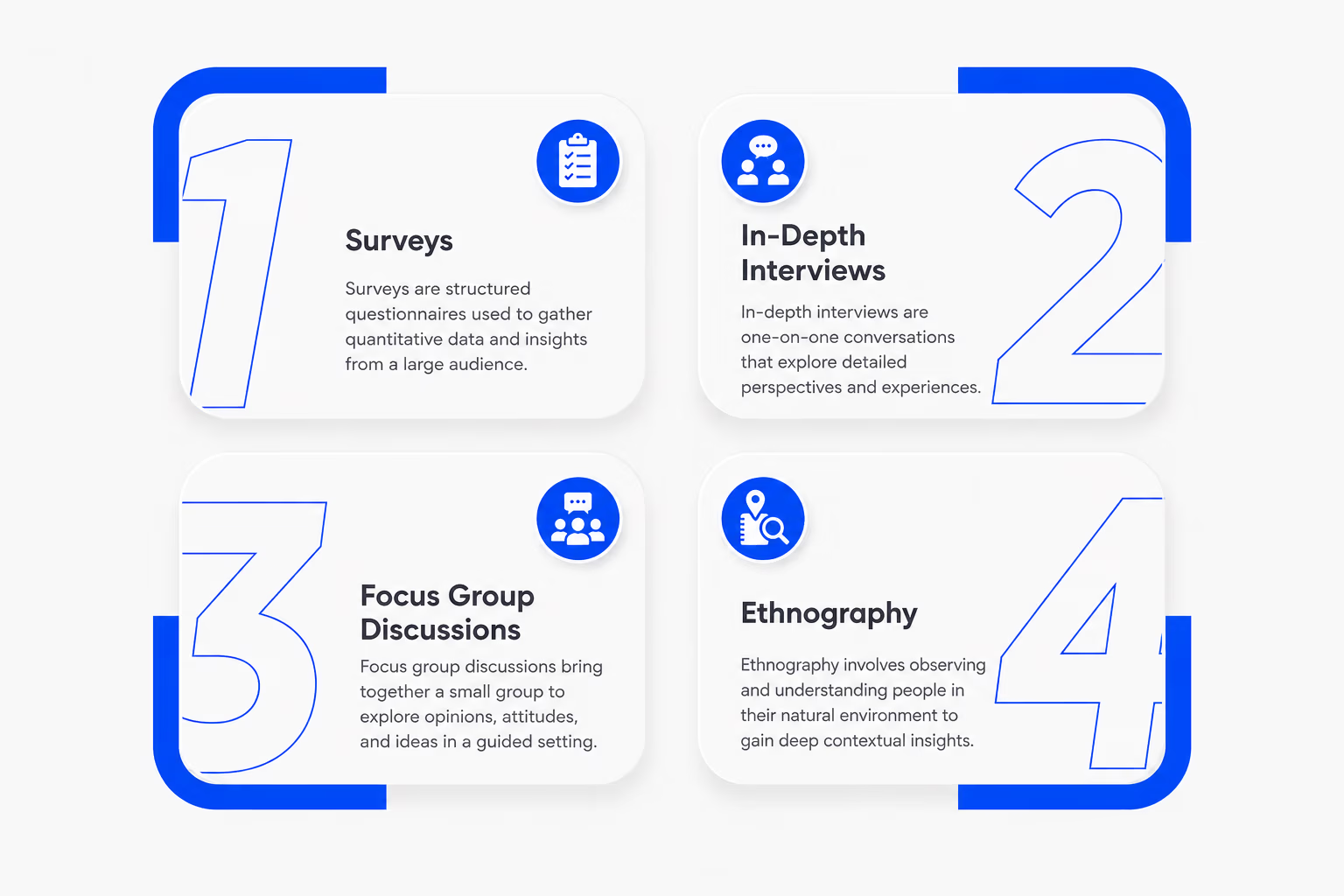
There are many market research methodologies, but four methods are especially important for GCC brands: surveys, in-depth interviews, focus group discussions, and ethnography.
Each method answers a different type of question.
1. Surveys: Measuring What the Market Thinks
Surveys are one of the most widely used market research methods because they collect structured responses from a larger group of people. They are useful when brands need measurable, comparable, and statistically useful data.
Surveys can be conducted through:
- Online panels
- Mobile surveys
- Website pop-ups
- Email surveys
- CATI or phone interviews
- In-store or intercept surveys
Surveys are useful for answering questions such as:
- How many people know our brand?
- Which concept is preferred?
- What price point is acceptable?
- Which features matter most?
- How satisfied are customers?
- Which segment is most likely to buy?
For example, a UAE-based food delivery brand may use surveys to compare customer expectations around delivery speed, discounts, subscription plans, and restaurant variety. A Saudi retail chain may use surveys to measure awareness and purchase intent before opening stores in new cities.
Surveys work best when the questions are clear, the sample is well-designed, and the data is cleaned properly. Poor survey design can produce misleading results, especially if questions are leading, answer options are incomplete, or the sample does not represent the target market.
2. IDIs: Understanding Deep Individual Motivations
IDIs, or in-depth interviews, are one-on-one conversations with respondents. They are used when businesses need detailed, personal, and contextual understanding.
Unlike surveys, IDIs are not designed to measure how many people think something. They are designed to understand why people think, feel, decide, hesitate, or switch.
IDIs are useful for exploring:
- Purchase motivations
- Trust barriers
- Brand perceptions
- Emotional triggers
- Customer pain points
- B2B decision-making
- Sensitive or complex topics
- High-value customer journeys
For example, a wealth management company in Dubai may use IDIs to understand how high-net-worth individuals evaluate financial advisors. A healthcare provider in Qatar may interview patients to understand concerns around telemedicine, privacy, and doctor credibility.
IDIs are especially useful in GCC markets because many decisions are shaped by cultural expectations, family influence, trust, service standards, and social perception. These factors may not appear clearly in survey data unless they are first explored qualitatively.
A skilled market researcher uses IDIs to uncover hidden drivers behind behavior, not just surface-level opinions.
3. FGDs: Exploring Group Reactions and Social Influence
FGDs, or focus group discussions, bring a small group of participants together to discuss a topic, product, concept, brand, or experience. A moderator guides the conversation while participants respond to questions and react to each other’s views.
FGDs are useful when brands want to observe group-level reactions.
They are often used for:
- Concept testing
- Ad testing
- Packaging feedback
- Brand perception studies
- Product improvement
- Communication testing
- Exploring category language
For example, a beauty brand entering the GCC may run FGDs with women from different age groups to understand expectations around ingredients, fragrance, packaging, influencer trust, and premium cues. A tourism brand may test different campaign messages with residents and visitors to see which destination promise feels most compelling.
FGDs are valuable because they show how people discuss a topic socially. Participants may build on each other’s ideas, challenge claims, or reveal language that brands can later use in messaging.
However, FGDs also have limitations. Dominant participants can influence the group. Some respondents may avoid honest disagreement. Sensitive topics may not work well in a group setting. That is why FGDs should be used carefully and often combined with surveys or IDIs.
4. Ethnography: Observing Real Behavior
Ethnography is one of the most powerful but often underused methods of market research. It involves observing people in real environments rather than only asking them questions.
This can include:
- In-home observation
- In-store observation
- Mobile diaries
- Shopper shadowing
- Workplace observation
- Digital behavior diaries
- Customer journey observation
Ethnography is useful because people do not always behave the way they say they behave. A shopper may claim price is the top factor, but in-store observation may show that shelf placement, packaging, or family preference drives the final decision.
For example, a supermarket chain in Kuwait may use ethnography to observe how families shop during weekends. A quick-service restaurant in Riyadh may study how customers order, wait, customize meals, and respond to service delays. A fintech app in Bahrain may use digital diaries to understand when users check balances, send money, or abandon transactions.
Ethnography is especially valuable in GCC markets where household roles, family decisions, service expectations, and lifestyle habits can strongly influence behavior.
GCC Examples: When Brands Should Use Primary Research
Primary research is useful across many GCC business situations.
A brand should consider it when:
- Entering a new GCC market: To understand demand, competitors, pricing, and cultural fit.
- Launching a new product: To test concept appeal, usage barriers, and purchase intent.
- Improving customer experience: To identify friction across stores, apps, call centers, and delivery journeys.
- Testing communication: To know whether claims feel credible, relevant, and locally appropriate.
- Segmenting customers: To identify high-value groups and tailor marketing strategies.
- Studying digital behavior: To understand how customers search, compare, review, and buy online.
- Exploring premiumization: To see whether consumers will pay more for quality, exclusivity, service, or convenience.
For example, a hospitality brand in Dubai may use surveys to measure guest satisfaction, IDIs to understand premium expectations, FGDs to test campaign messaging, and ethnography to observe the actual arrival and check-in experience.
Each method reveals a different layer of insight.
Quality Risks in Primary Market Research
Primary research is powerful, but only when quality is controlled. Poor execution can lead to confident but incorrect conclusions.
Common quality risks include:
- Weak sampling
- Biased questions
- Low-quality respondents
- Duplicate responses
- Speeders and straight-liners
- Poor translation
- Cultural misunderstanding
- Moderator bias
- Overgeneralizing small qualitative samples
- Ignoring non-response bias
- Treating opinions as proven behavior
In GCC markets, multilingual research adds another risk. A question written in English may not carry the same meaning in Arabic, Hindi, Urdu, Malayalam, or Tagalog. Translation must preserve intent, not just words.
Sampling is another major issue. If a study claims to represent UAE consumers but only captures one city, one income group, or one nationality cluster, the results may be misleading.
A strong market researcher builds controls into the study from the beginning. This includes screening, quota design, quality checks, pilot testing, validation, and transparent reporting of limitations.
The Automation Layer in Primary Research
Primary research is also changing because of automation. The goal is not to remove human expertise, but to reduce manual effort, improve speed, and make research workflows more consistent.
Automation can support:
- Questionnaire drafting
- Survey logic checks
- Sample monitoring
- Data cleaning
- Open-text coding
- Sentiment analysis
- Theme detection
- Translation support
- Report structuring
- Dashboard updates
This is particularly useful when dealing with large volumes of survey responses, open-ended comments, customer feedback, or multilingual data.
For example, open-ended survey responses can be automatically grouped into themes, then reviewed by researchers for accuracy. Interview transcripts can be processed faster to identify recurring motivations, objections, and emotional patterns. Survey logic can be checked before launch to reduce errors.
However, automation should not replace methodological judgment. AI can process data quickly, but it still needs human review to avoid misclassification, cultural misreading, or shallow interpretation.
The strongest research workflows combine automation with expert oversight.
Final Thoughts
Primary market research helps GCC brands move from assumption to evidence. It gives businesses direct access to customer needs, motivations, expectations, barriers, and behaviors.
Surveys provide measurable answers. IDIs reveal deeper motivations. FGDs show group reactions and language. Ethnography captures real-world behavior. Together, these market research methodologies help brands understand not only what people say, but why they act.
In GCC markets, where culture, income, language, nationality, digital behavior, and service expectations vary widely, primary research is not just useful. It is essential.
The brands that use the right market research methods can launch smarter, price better, communicate more clearly, improve experiences, and reduce costly decision risk.
In a region moving this fast, the advantage belongs to businesses that listen before they act.
.avif)