What proportion of the target population do you need to interview to get results representative of the target population with the level of confidence that you are willing to accept?
What Is Sample Size in Market Research?
Sample size refers to the number of respondents included in a research study or survey.
Instead of surveying an entire population, researchers collect responses from a smaller group or sample - to estimate broader trends and behaviors.
The goal is simple: to ensure the sample accurately represents the larger population.
For example:
A study about smartphone preferences in the United States does not require responses from all 330+ million Americans. Instead, researchers calculate an appropriate sample size capable of producing statistically reliable insights within an acceptable confidence range.
This is why sample size calculations are critical in market research.
Why Sample Size Is So Important
Sample size directly affects the reliability of research findings.
If the sample is too small:
- results become unstable
- margins of error increase
- trends may become misleading
- statistical confidence weakens
If the sample is unnecessarily large:
- research costs increase
- fieldwork becomes inefficient
- data processing complexity grows
Modern research therefore focuses on finding the optimal balance between:
- reliability
- precision
- operational efficiency
This is why researchers increasingly use:
- sample size calculators
- sample size equations
- confidence level equations
- power calculation calculators
to determine statistically appropriate sample sizes before fieldwork begins.
What Is a Confidence Level?
One of the most important concepts in sample size calculation is the confidence level.
The confidence level measures how certain researchers are that survey results reflect the broader population.
Common confidence levels include:
- 90%
- 95%
- 99%
In market research, 95% confidence level is most commonly used.
This means researchers are 95% confident that the survey results fall within the selected margin of error.
Many researchers searching:
- what is confidence level
- how to find confidence level
- confidence level equation
are essentially trying to understand how statistical confidence affects survey reliability.
What Are Confidence Limits?
Confidence limits define the range within which the true population value is expected to fall.
For example:
If 60% of respondents prefer a product with a ±5% margin of error, the actual population result likely falls between:
- 55% and 65%
This range is called the confidence interval or confidence limits.
The smaller the confidence limits:
the more precise the research findings become.
The Basic Sample Size Formula
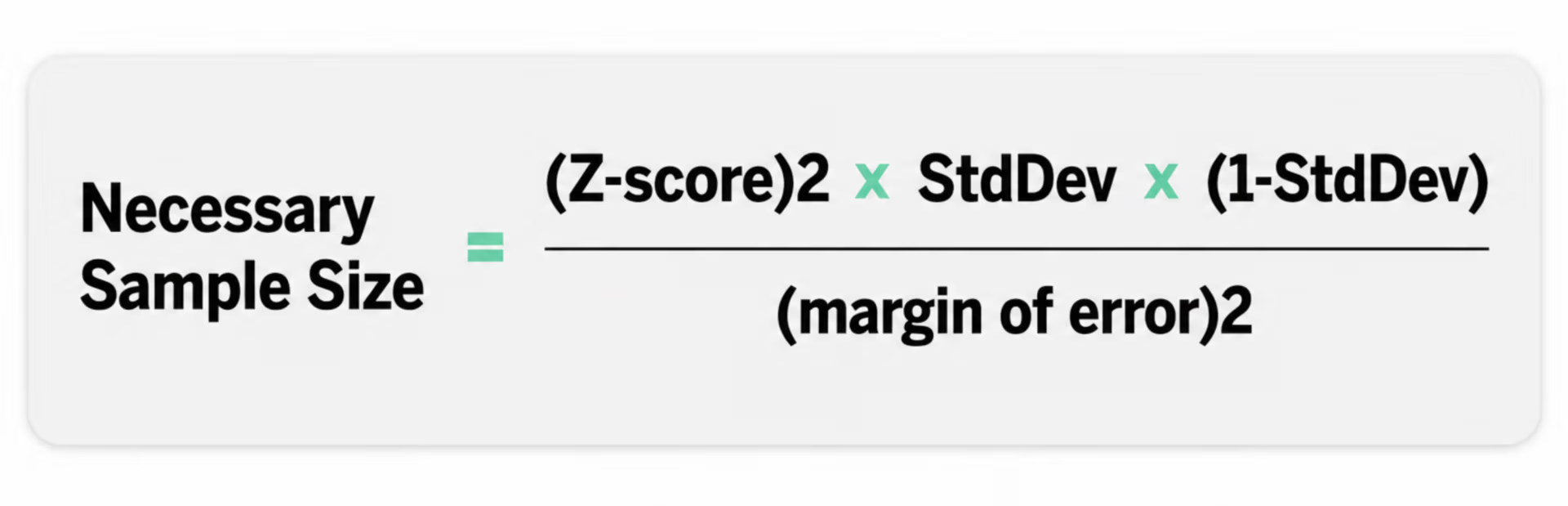
One of the most common sample size calculation equations used in market research is:
n=Z2×p(1−p)e2n = \frac{Z^2 \times p(1-p)}{e^2}n=e2Z2×p(1−p)
Where:
- n = required sample size
- Z = confidence level score
- p = estimated population proportion
- e = margin of error
This sample determination formula helps researchers calculate statistically reliable sample sizes before launching surveys.
Sample Size Calculation Example
Let’s say researchers want to conduct a national consumer survey.
Inputs:
- Population size: 1,000,000
- Confidence level: 95%
- Margin of error: 5%
- Response distribution: 50%
Using a determining sample size calculator, the recommended sample size would be approximately:
385 respondents.
This is why many national surveys often use sample sizes between:
- 350–500 respondents
for broad directional insights.
Why Researchers Use 50% Response Distribution
Many sample size calculators default to a 50% response distribution.
Why?
Because 50% creates the maximum variability scenario, making the sample size statistically conservative and safer for general research applications.
Unless researchers already know likely population behavior, 50% is commonly recommended.
The Relationship Between Margin of Error and Sample Size
Margin of error and sample size are directly connected.
Smaller margins of error require larger sample sizes.
Example:
Margin of Error - Approximate Sample Size±10%~100±5%~385±3%~1,067
This is why highly precise studies often become significantly more expensive operationally.
What Is Statistical Power in Research?
Another increasingly important concept is statistical power.
Researchers searching:
- statistical power analysis calculator
- power calculation calculator
- how to calculate power stats
are typically trying to determine whether their study can reliably detect meaningful differences or effects.
Statistical power measures the probability that a study correctly identifies a real effect rather than missing it due to insufficient sample size.
In many quantitative studies: 80% statistical power is considered standard.
Common Mistakes in Sample Size Determination
One of the biggest problems in market research is assuming larger sample sizes automatically produce better research.
That is not always true.
Several factors affect research reliability beyond sample size alone, including:
- respondent quality
- sampling method
- incidence rates
- questionnaire design
- data cleaning quality
Some common mistakes include:
- Using Extremely Small Samples - Small samples often create unstable findings and exaggerated variability.
- Oversampling Without Strategic Need - Larger samples increase costs and operational complexity unnecessarily.
- Ignoring Population Structure - A large sample alone cannot fix poor audience representation.
- Confusing Confidence With Accuracy - A high confidence level does not automatically guarantee valid research if sampling methodology itself is flawed.
Why Sample Size Calculation Is Becoming More Important
Modern research environments are becoming increasingly data-intensive.
Today’s studies often involve:
- multiple markets
- digital panels
- longitudinal tracking
- behavioral segmentation
- large-scale quantitative analysis
As datasets become more complex, researchers are placing greater emphasis on:
- methodological reliability
- statistical defensibility
- analytical consistency
This is why searches for:
- sample size calculators
- sample size equation
- sample size calculation equation
- determine sample size
continue growing rapidly across research communities.
Sample Size in Quantitative vs Qualitative Research
Sample size expectations differ substantially across methodologies.
Quantitative Research
Quantitative studies prioritize:
- statistical representation
- measurable trends
- numerical reliability
Sample sizes are generally larger.
Qualitative Research
Qualitative studies prioritize:
- depth of insight
- emotional nuance
- behavioral understanding
- contextual richness
Smaller samples are often sufficient because the goal is not statistical projection.
Why Data Quality Still Matters More Than Scale
One of the biggest misconceptions in modern market research is that larger datasets automatically create more reliable findings.
But sample size alone cannot fix:
- poor-quality participation
- inconsistent respondents
- duplicate records
- AI-generated responses
- fragmented datasets
This is why modern research increasingly combines:
- sample size rigor
- validation workflows
- contextual analysis
- intelligence-led quality systems
to improve overall research reliability.
Best Practices for Sample Size Calculation
As market research continues evolving, several best practices are becoming increasingly important.
- Define Confidence Level Early- Researchers should establish statistical confidence requirements before fieldwork begins.
- Align Sample Size With Research Objectives - Different studies require different levels of precision.
- Consider Population Variability - Highly diverse audiences may require larger samples.
- Focus on Data Quality Alongside Sample Size - Large samples cannot compensate for unreliable participation or inconsistent datasets.
Conclusion
Sample size calculation remains one of the most important foundations of statistically reliable market research. From confidence levels and confidence limits to margin of error and statistical power, selecting the right sample size directly affects the stability, reliability, and defensibility of research findings.
As research environments become increasingly digital and data-intensive, researchers are relying more heavily on sample size calculators, sample determination formulas, and statistical validation methods to improve quantitative reliability before fieldwork even begins.
At the same time, modern market research is increasingly recognizing that sample size alone is not enough. Reliable research now depends on combining statistical rigor with structured validation, contextual consistency, and intelligence-led workflows capable of maintaining analytical reliability throughout the research process itself.