
Why Low-Quality Survey Responses Have Become a Major Research Problem
Modern market research depends heavily on data reliability.
But as online surveys scale globally, researchers are facing a growing operational challenge:
removing low-quality survey responses before they distort research findings.
Today’s online research environments generate enormous response volumes across:
- surveys
- mobile panels
- online communities
- digital feedback systems
- behavioral research platforms
At the same time, low-quality participation has increased significantly due to:
- survey fatigue
- incentive-driven participation
- rushed responding
- duplicate entries
- AI-assisted answers
- disengaged respondents
This creates a serious problem for research teams because unreliable responses can compromise:
- statistical analysis
- segmentation models
- brand tracking
- behavioral insights
- thematic interpretation
- decision-making accuracy
In some online studies, researchers estimate that 10-30% of collected responses may require quality review or removal, particularly in large-scale digital survey environments.
As a result, removing low-quality survey responses has become one of the most important operational steps in modern market research workflows.
What Are Low-Quality Survey Responses?
Low-quality survey responses refer to answers that are unreliable, inconsistent, disengaged, incomplete, or behaviorally suspicious enough to reduce the analytical reliability of a study.
These responses may include:
- rushed participation
- random answering
- duplicate responses
- contradictory information
- straightlining patterns
- AI-generated text
- low-effort open-ended answers
Importantly, low-quality responses are not always intentionally fraudulent.
In many cases, participants simply:
- lose attention
- rush for incentives
- abandon engagement midway
- respond carelessly
The challenge for researchers is determining which responses should remain in the dataset—and which should be removed before analysis begins.
Why Removing Low-Quality Responses Matters
Even a relatively small percentage of unreliable responses can distort research findings significantly.
For example:
- a pricing study may produce inaccurate willingness-to-pay estimates
- brand perception tracking may become unstable
- segmentation analysis may create misleading audience clusters
- sentiment analysis may become artificially skewed
In quantitative studies, low-quality responses introduce statistical noise that weakens analytical consistency.
In qualitative studies, poor responses may create:
- misleading themes
- repetitive narratives
- artificial sentiment patterns
- weak contextual interpretation
This is why modern research increasingly treats response-quality management as a foundational part of research methodology—not simply a post-processing cleanup step.
How Researchers Identify Low-Quality Responses
1. Speeding Detection
One of the most common techniques involves identifying respondents who complete surveys unrealistically quickly.
Researchers compare:
- expected completion time
- question complexity
- reading behavior
- interaction duration
against actual survey timing.
For example:
A survey designed to require 15 minutes of thoughtful engagement may raise quality concerns if completed in:
- 2 minutes
- 3 minutes
- or even under 5 minutes
Studies across online research environments consistently show that extremely fast responses often correlate with:
- lower accuracy
- reduced engagement
- inconsistent answers
This is why speeding detection remains one of the most widely used quality-control methods.
2. Straightlining Analysis
Straightlining occurs when respondents repeatedly select the same answer pattern across multiple questions without meaningful variation.
Researchers analyze:
- repeated scale selections
- matrix consistency patterns
- lack of response variability
to identify disengaged participation behavior.
For example:
Selecting:
- “Strongly Agree”
for 20 consecutive matrix questions may indicate low-attention participation.
Straightlining becomes especially problematic in long quantitative surveys where fatigue increases over time.
3. Attention Check Questions
Attention checks are designed to determine whether respondents are actively reading survey content.
Example:
“Please select ‘Neutral’ for this question.”
Respondents who fail multiple attention checks are often flagged for quality review.
However, modern research teams increasingly recognize that attention checks alone are insufficient because many experienced respondents now anticipate these validation methods.
4. Open-Ended Response Review
One of the fastest-growing areas of survey quality control involves evaluating qualitative responses.
Researchers review open-ended answers for:
- repetitive phrasing
- copied responses
- meaningless text
- semantic inconsistency
- AI-generated language patterns
Low-quality open-ended responses often include:
- extremely short answers
- irrelevant text
- generic phrasing
- repeated sentence structures
As generative AI tools become more accessible, qualitative response review has become increasingly important in modern survey validation.
5. Logic and Consistency Checks
Researchers frequently evaluate whether survey responses remain logically consistent throughout the questionnaire.
Examples include:
- contradictory demographic information
- unrealistic household structures
- impossible age and employment combinations
- inconsistent behavioral claims
Consistency validation helps researchers identify structurally unreliable participation.
6. Duplicate Response Detection
Online survey environments increasingly face issues involving duplicate participation.
Researchers identify duplicates through:
- email similarity
- device signals
- participation history
- response matching
- IP review
Even small levels of duplicate participation can distort quantitative findings significantly - especially in smaller sample studies.
7. Behavioral Pattern Analysis
Modern quality-control systems increasingly evaluate respondent behavior itself.
Researchers now analyze:
- scrolling patterns
- click timing
- hesitation behavior
- navigation consistency
- interaction flow
This helps identify respondents who appear behaviorally disengaged or artificially optimized.
Behavioral review is becoming increasingly important because low-quality participation is becoming more sophisticated and difficult to identify through traditional validation methods alone.
Why Removing Low-Quality Responses Is Becoming Harder
Identifying low quality responses is becoming more challenging than ever. Historically, poor-quality responses were easier to identify.
Researchers mainly looked for:
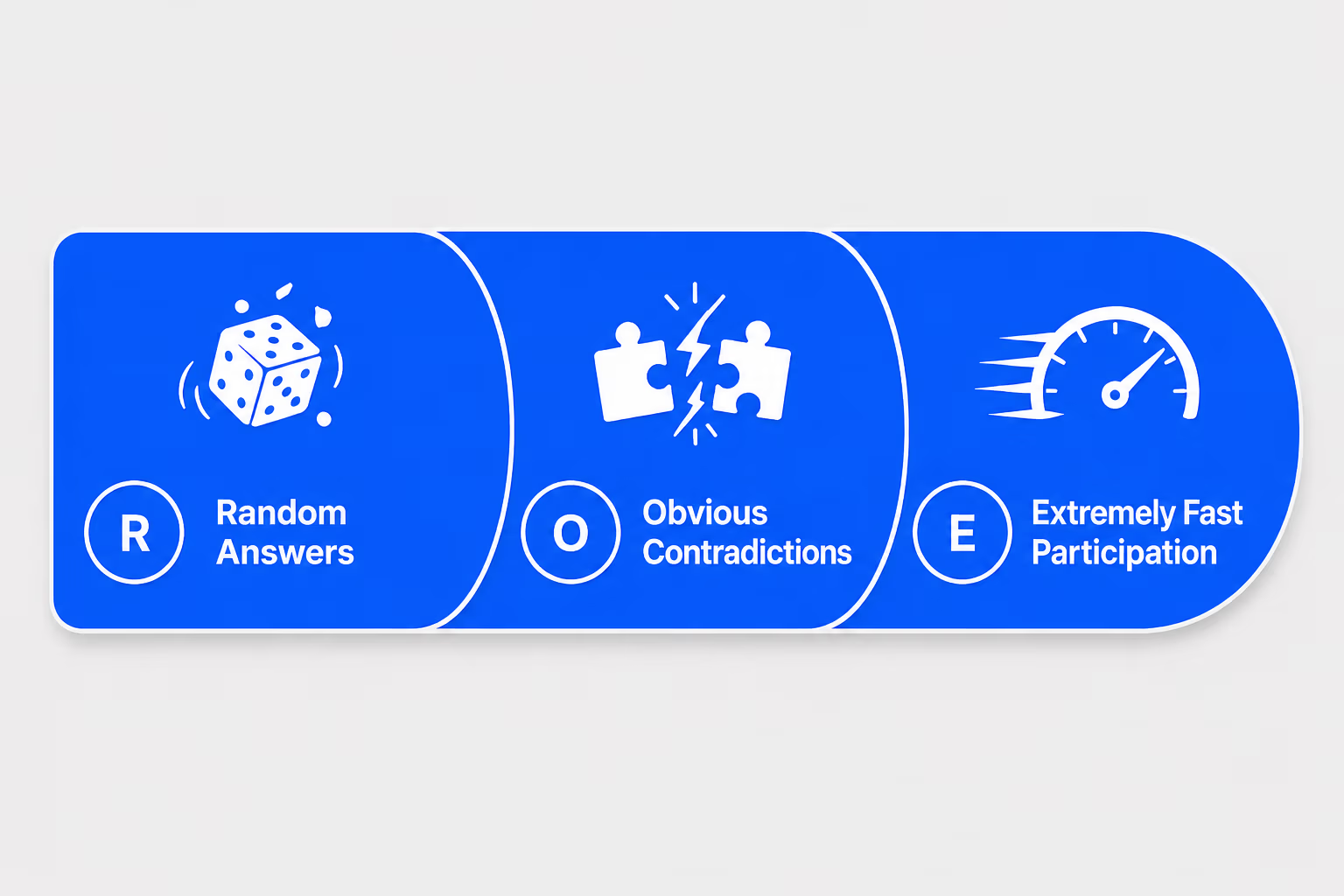
- random answers
- obvious contradictions
- extremely fast participation
But modern online research environments are becoming much more complex.
Today’s low-quality participation may include:
- AI-assisted responses
- strategically slowed speeding behavior
- realistic open-ended phrasing
- adaptive answer variation
This makes low-quality response detection substantially more difficult than before.
Researchers increasingly describe response validation as one of the fastest-growing operational challenges in online market research.
The Operational Cost of Poor-Quality Data
Low-quality survey responses create major operational inefficiencies across research workflows.
Research teams often spend substantial time on:
- manual review
- data cleaning
- response validation
- sample replacement
- quality assurance checks
Poor-quality data may also lead to:
- delayed reporting
- reduced usable sample sizes
- unstable analytics
- inconsistent findings
In large-scale online studies, even removing 15-20% of responses can significantly affect timelines, quotas, and statistical confidence.
The Shift Toward Layered Quality-Control Systems
Traditional survey validation often relied on:
- one or two attention checks
- speeding thresholds
- duplicate removal
That approach is increasingly insufficient.
Modern research environments now require layered validation systems combining:
- behavioral analysis
- contextual evaluation
- qualitative review
- response consistency modeling
- structured validation workflows
This reflects a broader shift toward continuously evaluating respondent reliability throughout the research process itself.
Intelligence-Led Survey Validation
As datasets become more complex, many organizations are moving toward intelligence-powered quality-control systems capable of evaluating both:
- statistical consistency
- contextual authenticity
Platforms such as BioBrain Insights reflect this shift through intelligence-powered and professionally-led research systems designed to strengthen research reliability beyond traditional survey-cleaning workflows.
Approaches such as the RRR Framework - focused on recency, relevance, and resonance help identify contextually meaningful research signals within large-scale datasets, while systems such as InstaQual support deeper evaluation of interviews, open-ended responses, and discussion-based research through transcript structuring, thematic synthesis, and contextual validation workflows.
This reflects a broader industry movement toward continuously assessing:
- response authenticity
- contextual consistency
- analytical reliability
- qualitative integrity
throughout modern research operations.
Best Practices for Removing Low-Quality Responses
As research environments continue evolving, several best practices are becoming increasingly important.
Use Multiple Validation Layers
No single validation method is sufficient on its own.
Researchers increasingly combine:
- speeding analysis
- consistency review
- behavioral evaluation
- qualitative assessment
- contextual validation
to improve reliability.
Review Open-Ended Responses Carefully
Qualitative answers now require deeper review due to increasing AI-assisted participation.
Monitor Quality During Fieldwork
Continuous validation helps reduce large-scale contamination before analysis begins.
Prioritize Context Alongside Automation
Automated systems improve speed, but contextual interpretation remains essential for identifying sophisticated low-quality participation behavior.
Conclusion
Removing low-quality survey responses has become one of the most important operational processes in modern market research. As online surveys continue scaling globally, researchers increasingly face challenges involving disengaged participation, inconsistent responses, duplicate entries, and AI-assisted answering behavior that can compromise analytical reliability.
This is why modern research workflows increasingly rely on layered validation systems combining behavioral analysis, qualitative review, response consistency modeling, and intelligence-led quality-control approaches capable of continuously evaluating response authenticity throughout the research process itself.
As research environments become more complex, maintaining reliable datasets will depend not only on collecting responses at scale - but on ensuring those responses remain contextually reliable, methodologically defensible, and analytically trustworthy before insights are generated.
.avif)