
What is Market Research
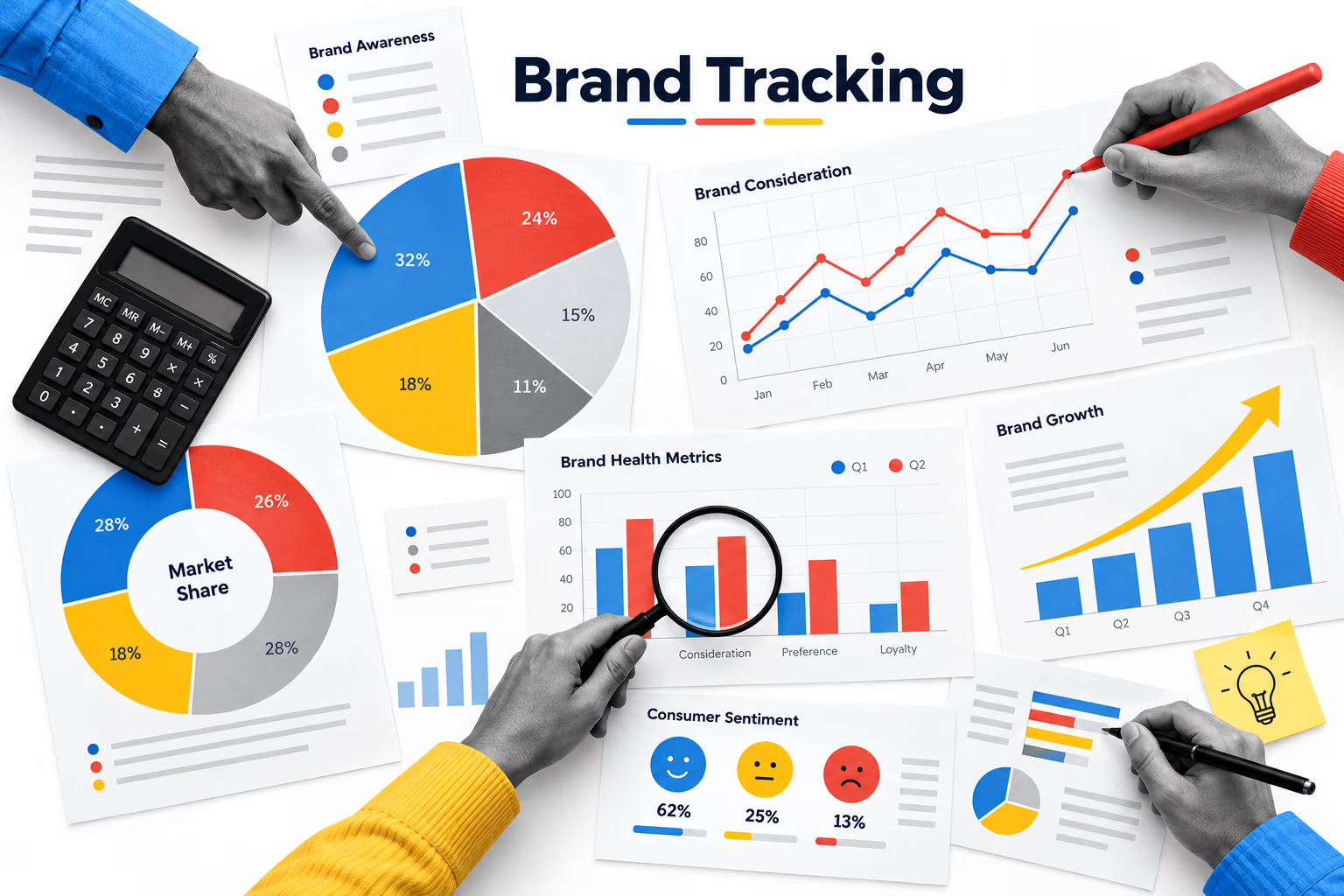
Market research is the process of collecting, analyzing, and interpreting information about consumers, markets, competitors, products, pricing, behavior, and demand so businesses can make better decisions.
In simple terms, market research helps businesses understand what people need, what they buy, why they choose, what they reject, how markets shift, and where opportunities exist.
But modern market research is no longer only about surveys and reports. Businesses now need faster answers, sharper consumer intelligence, real-time market signals, and decision-ready insights. This is where market research intelligence platforms become important.
A market research intelligence platform helps teams collect data, analyze consumer behavior, test ideas, monitor market signals, and turn evidence into business action. These platforms support product launches, brand strategy, customer experience, pricing, advertising, innovation, market entry, and competitive positioning.
Advantages of Market Research Intelligence Platforms
Market research intelligence platforms help businesses move from slow research cycles to continuous insight systems.
Key advantages include:
- faster access to consumer feedback
- better product and concept testing
- stronger brand and campaign decisions
- clearer pricing and packaging insights
- real-time tracking of consumer sentiment
- structured analysis of open-ended feedback
- better understanding of target segments
- stronger collaboration between research, marketing, product, and strategy teams
- reduced dependence on manual reporting
- improved decision-making across markets and categories
The best platforms do not simply collect data. They help teams interpret what the data means and what to do next.
What Makes a Market Research Intelligence Platform Useful?
A strong market research intelligence platform should help businesses answer practical questions.
For example:
- Which concept should we launch?
- Which message performs better?
- What do consumers think about our brand?
- What complaints are growing online?
- Which product feature matters most?
- What price range feels acceptable?
- How is our campaign performing?
- What does consumer sentiment reveal?
- Which audience segment should we prioritize?
Useful platforms usually combine speed, research design, consumer access, automation, analytics, dashboards, reporting, collaboration, and expert interpretation.
The right platform depends on the business need. Some platforms are stronger for fast surveys. Some are built for innovation testing. Some focus on social and media intelligence. Some combine research automation, Web Intelligence, and managed research workflows.
Below are five market research intelligence platforms brands should know.
1. Appinio
Appinio is a market research platform focused on fast consumer insights, AI-powered research workflows, survey creation, analysis, and real-time reporting. It is designed to help companies collect consumer feedback and turn it into actionable insights for business decisions.
Appinio is useful for teams that need to run surveys, test ideas, collect feedback, analyze responses, and share results quickly.
How Appinio Works
Appinio helps users create and launch research studies through a digital platform. Teams can design surveys, collect responses from target audiences, analyze data, apply filters, review open-text responses, and create insight stories.
The platform is positioned around making market research more accessible, faster, and easier to use. It supports research workflows where teams need consumer input without waiting for long traditional research timelines.
Appinio USP
- AI-powered survey and research platform
- Designed for fast consumer feedback
- Supports survey creation, analysis, and reporting
- Helps convert raw data into insight stories
- Useful for concept testing, brand research, product feedback, and consumer understanding
- Enables teams to collaborate and share findings
- Strong fit for brands that need quick, structured consumer insight
Appinio works well for businesses that want fast survey-led intelligence with a user-friendly platform experience.
2. Zappi
Zappi is a consumer insights platform built around innovation, creative testing, and iterative learning. It helps brands test ideas, concepts, packaging, pricing, advertising, and consumer responses before scaling decisions.
Zappi is especially relevant for teams that want to bring the consumer voice into product development, marketing, and brand-building workflows.
How Zappi Works
Zappi helps brands test and learn with consumers across different stages of innovation and advertising. Teams can evaluate early ideas, product concepts, packaging routes, pricing, and creative assets.
The platform is structured around repeated testing, learning, and iteration. Instead of treating research as one isolated study, Zappi supports a more connected research system where teams can compare results, improve stimuli, and make better decisions over time.
Zappi USP
- Strong focus on consumer-led innovation
- Supports concept testing, packaging testing, price research, and creative testing
- Helps brands iterate ideas before launch
- Built for research consistency and repeat learning
- Useful for product, marketing, advertising, and brand teams
- Helps teams connect consumer feedback to in-market decision-making
- Strong fit for brands managing high-volume innovation pipelines
Zappi is a strong platform for businesses that need structured consumer testing across innovation and advertising decisions.
3. Meltwater
Meltwater is an intelligence platform that combines media monitoring, social listening, consumer insights, influencer intelligence, and public conversation analysis. It helps brands understand what consumers, media, and markets are saying across digital channels.
Meltwater is useful for teams that need to monitor reputation, brand perception, sentiment, public conversations, competitor activity, and media impact.
How Meltwater Works
Meltwater collects and analyzes signals from sources such as news, social media, blogs, forums, reviews, and other public digital channels. The platform helps users monitor conversations, identify sentiment, track brand mentions, analyze media coverage, and understand consumer themes.
For market research intelligence, Meltwater is especially useful when brands need to understand the voice of the market beyond surveys. It helps teams detect what people are discussing publicly and how those discussions change over time.
Meltwater USP
- Strong media intelligence and social listening capabilities
- Tracks public conversations across multiple digital sources
- Supports consumer insights through sentiment and theme analysis
- Useful for brand monitoring, PR, reputation, and competitor tracking
- Combines media, social, influencer, and business data
- Helps identify emerging issues, consumer reactions, and market signals
- Strong fit for teams that need real-time external intelligence
Meltwater is a strong choice for businesses that want market intelligence from public digital conversations, media coverage, and social signals.
4. Suzy
Suzy is an on-demand consumer insights platform designed to help brands gather rapid feedback from consumers. It supports quantitative and qualitative research, product testing, concept testing, price testing, packaging feedback, and video-based consumer input.
Suzy is positioned for enterprise brands that need quick consumer feedback for marketing, innovation, product development, and business decisions.
How Suzy Works
Suzy helps teams collect direct feedback from target consumers through its research platform. It supports different research approaches, including qualitative feedback, one-on-one consumer interviews, virtual discussions, concept testing, monadic testing, maxdiff testing, price testing, and video feedback.
The platform helps businesses understand what consumers think, why they react, and how ideas can be improved before launch.
Suzy USP
- On-demand consumer insights platform
- Supports both qualitative and quantitative research
- Offers tools for concept testing, package testing, price testing, and product feedback
- Includes video and interview-based consumer feedback capabilities
- Useful for enterprise brands that need fast consumer input
- Helps teams understand both what consumers prefer and why
- Strong fit for product innovation, marketing, and consumer validation
Suzy is valuable for businesses that need quick, direct consumer feedback with a mix of structured and qualitative insight.
5. BioBrain Insights
BioBrain Insights is a market research intelligence platform that combines AI, automation, Market Research Operations, Web Intelligence, and expert oversight. It is designed to help businesses move from research inputs to decision-ready insights with greater speed, structure, and quality.
BioBrain supports teams that need Questionnaire Automation, data quality workflows, data cleaning, coding, tagging, open-text analysis, dashboarding, reporting, and Web Intelligence for analyzing consumer signals.
How BioBrain Insights Works
BioBrain helps automate and streamline key stages of the market research workflow. Its capabilities cover survey programming support, quality checks, data validation, data cleaning, coding, tagging, analysis structuring, open-text analysis, dashboarding, reporting, and Web Intelligence.
The platform combines automation with market research expertise. This makes it useful for brands and research teams working with complex surveys, large datasets, open-ended responses, and public consumer signals.
BioBrain Insights USP
- Combines AI, automation, and expert oversight across market research workflows
- Supports end-to-end Market Research Automation across Quantitative Research, Qualitative Research, and Web Intelligence
- Offers Questionnaire Automation for converting research inputs into online-ready survey workflows
- Includes data quality checks, validation, cleaning, coding, tagging, and analysis structuring
- Supports open-text analysis through sentiment analysis, topic modeling, contextual understanding, automated summarization, and structured output creation
- Uses Web Intelligence to analyze public consumer signals through semantic clustering and expert-led refinement
- Helps teams move from research operations to insight presentation through dashboarding, reporting, and decision-ready outputs
BioBrain Insights is especially relevant for teams that need more than a single research tool. It connects automation, quality workflows, Web Intelligence, and expert research interpretation into a practical intelligence system for business decision-making.
Types of Market Research
Market research can be divided into several key types. Each type answers a different business question.
1. Primary Research
Primary research collects new data directly from consumers, customers, users, or target audiences.
Examples include:
- surveys
- interviews
- focus groups
- product tests
- concept tests
- customer satisfaction studies
- usability testing
Primary research is useful when a business needs direct answers from a specific audience.
2. Secondary Research
Secondary research uses existing information to understand a market, category, competitor, or audience.
Examples include:
- industry reports
- government data
- published studies
- competitor websites
- market databases
- trade publications
- historical performance data
Secondary research is useful for building context before conducting primary research.
3. Quantitative Research
Quantitative research measures data numerically. It helps businesses understand scale, frequency, preference, demand, satisfaction, awareness, and statistical patterns.
Examples include:
- customer surveys
- tracking studies
- pricing research
- brand awareness measurement
- concept scoring
- segmentation studies
Quantitative research is useful when businesses need measurable evidence.
4. Qualitative Research
Qualitative research explores the reasons behind consumer behavior. It helps teams understand motivation, emotion, language, barriers, and decision logic.
Examples include:
- interviews
- focus groups
- online communities
- open-ended survey responses
- video feedback
- diary studies
Qualitative research is useful when businesses need depth and explanation.
5. Web Intelligence and Sentiment Research
Web Intelligence analyzes public digital conversations, reviews, social media, forums, news, and user-generated content to understand consumer voice at scale.
It helps businesses track:
- sentiment
- complaints
- emerging trends
- category conversations
- competitor mentions
- brand perception
- unmet needs
- purchase barriers
This type of research is becoming more important because consumers express opinions continuously across digital channels.
6. Experimental Research
Experimental research tests cause and effect. It helps businesses understand whether a change produces a measurable outcome.
Examples include:
- A/B testing
- message testing
- price testing
- UX experiments
- product trials
- campaign experiments
Experimental research is useful when teams need to know what works before scaling a decision.
The strongest choice is not always the platform with the most features. It is the platform that fits the business question, research maturity, target audience, timeline, and decision need.
Final Thoughts
Market research intelligence platforms are changing how businesses understand consumers and make decisions.
Traditional market research helped companies collect feedback. Modern intelligence platforms help teams move faster, connect more signals, analyze more deeply, and act with greater confidence.
The best platforms do more than produce data. They help businesses understand what consumers think, feel, say, choose, reject, and expect next.
For smarter business decisions, companies need research systems that combine speed, quality, automation, consumer access, market signals, and strategic interpretation.
That is the future of market research intelligence: not just more data, but better decisions.